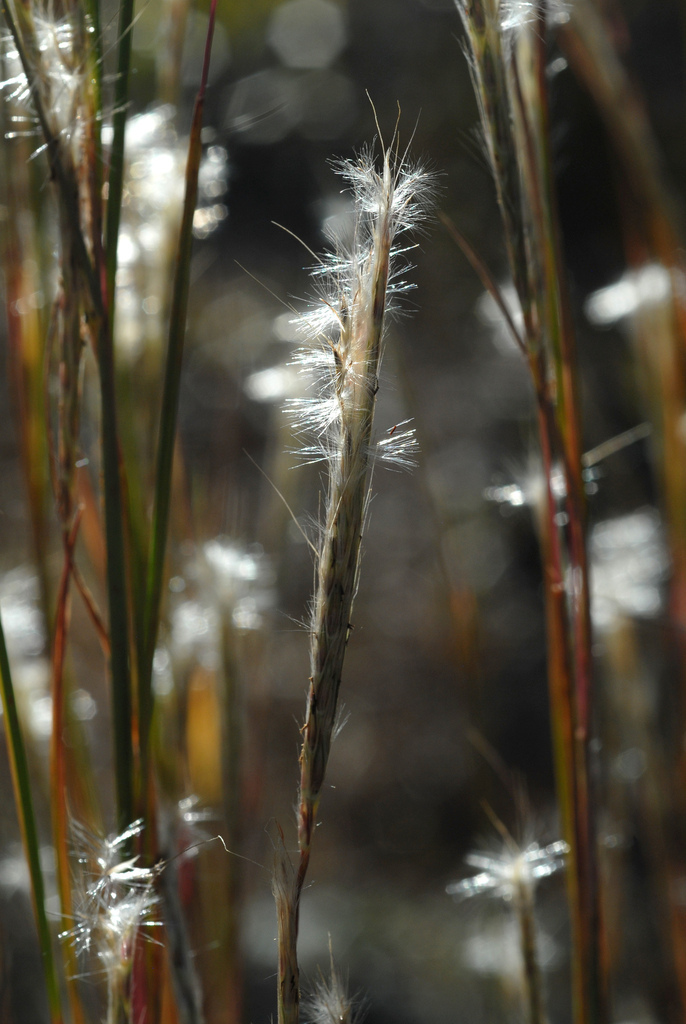
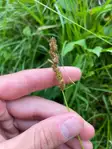
Enter your ZIP to see whether this is legal to plant in your state, and whether it survives your winter.
Splitbeard bluestem is highly flammable; NC State Extension’s high rating supports keeping it away from structures.
NC State University’s extension service and the U.S. Fish and Wildlife Service rated the grass extreme on a four-level flammability scale in 2005. NC State Extension removed the extreme category for its 2025 revision, leaving splitbeard bluestem rated high. The changed label does not establish that the plant became safer. The extension plant database also places the synonym Anatherum ternarium under its high-flammability tag; that name corresponds to Andropogon ternarius.
In a burning-bench test reported in FLAMITS, a whole, live plant tested without being dried first produced flame after 1.636 seconds. That measures ignition under a particular test setup, not how the grass will behave through every season or under every yard condition.
Splitbeard bluestem is a low-water grass in the Poaceae family. Hardy to USDA zone 5a, it reaches about 3.9 feet at maturity. Those traits do not outweigh the repeated high or extreme findings. For placement near a home, the practical conclusion is to choose another plant and keep this grass away from structures.
The complete three-table AG-874 plant list is explicitly for North Carolina and contains 202 low-, medium-, or high-flammability rows. FireApproved accounts for all source rows under its strict taxonomy and lineage rules; source scope does not establish local suitability at a particular North Carolina site.
2. Why this plant is relevant here
State distribution
Documented in AL, AR, DC, DE, FL, GA, IL, IN, KS, KY, LA, MD, MO, MS, NC, NJ, OK, SC, TN, TX, VA.
Native range
The legacy compatibility field lists NC in native range; its field-level source was not retained.
Introduced / established
USDA hardiness
Documented minimum 5a; no upper limit is documented.
3. Legal, ecological, and broader status
Legal-list status
Seed-list status
Reported invasive here
Broader regional context
Federal context
How to read this page
The status above is computed from the cited rows below: independent recommendations can support a fire-resistant result, an avoid row can produce keep-away, and disagreement stays visible as conflict. Placement notes preserve each source’s own scheme rather than translating unlike rules into one scale. This is evidence about a plant, not permission to plant it in every part of the defensible space; Zone 0 remains noncombustible.
Plant hardiness evidence
These values describe the plant source. Your ZIP zone comes from the separate 2023 USDA
Plant Hardiness Zone Map. Whole-zone values stay whole-zone, and a single unresolved value
is not treated as a tolerance range. Different source boundaries stay separate: overlapping
statements are compared independently, while only ranges with no shared zone are called a conflict.
Source location: PlantCharacteristics record 20361, Temperature, Minimum (°F).
Where its sources say to plant it
Placement rules below use each source's own distances or named zones, tied to its rating.
They are not interchangeable with the directory's current Zone 0 guidance.
North Carolina Extension Gardener Plant Toolbox: anatherum-ternarium [nc-toolbox-flammability-facet] (with its avoid rating)
The evidence
Grouped by what each source concluded. Primary evidence rated the plant itself
(a lab, field program, or original curation); corroboration compiled or
republished another source's rating and resolves to its root lineage.
8 cited rows from this source; its identity, lineage and tier are stated once.
Primary study Gao2022: Gao, X., & Schwilk, D. W. (2022). Burn hot or tolerate trees: flammability decreases with shade tolerance in grasses. Oikos, 4, e08930.
Shared row context: plant part whole plant; fuel live; predrying no; device burning bench; site Gao2022-1; sampling spring 2019.