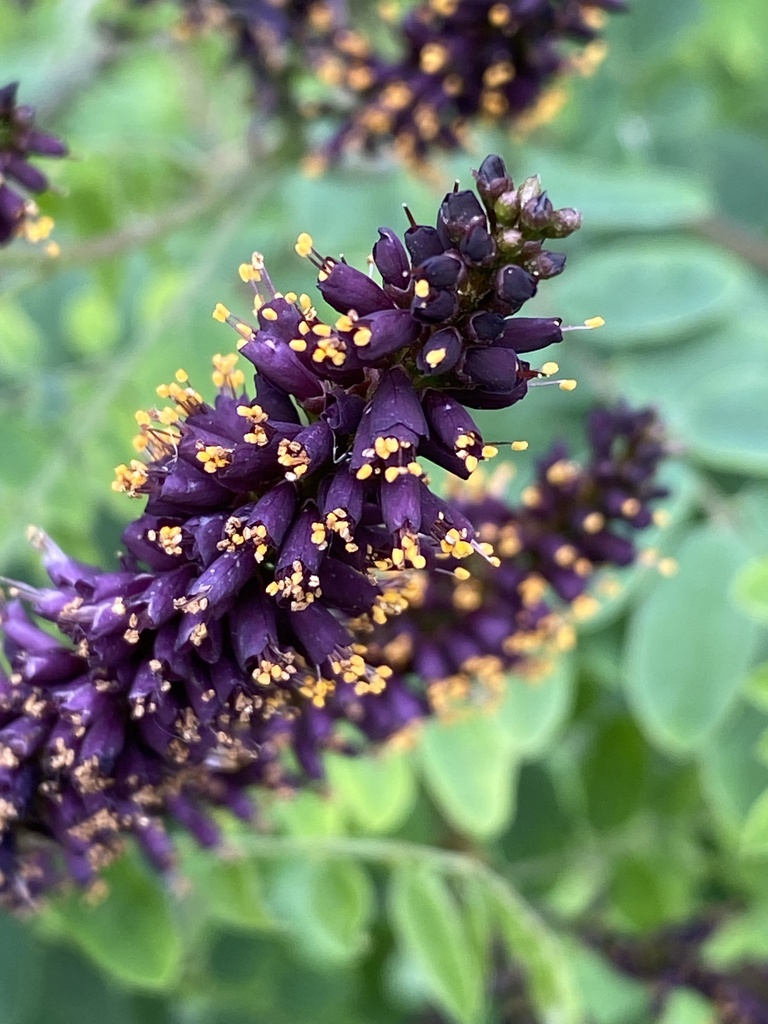
false indigo bush
Amorpha fruticosa
A genus split is not a placement verdict.
Is this one for your yard?
Enter your ZIP to see whether this is legal to plant in your state, and whether it survives your winter.
Yes, false indigo bush is generally rated fire resistant.
Ohio State and Virginia Tech both give it their low-flammability rating, while Oregon State profiles it among plants suited to fire-resistant landscaping in the Willamette Valley. Arizona’s extension service also recommends it above 3,000 feet.
The agreement reaches beyond those regions. New Mexico’s Forestry Division includes false indigo bush on its FireWise list from 4,000 through 7,000 feet, marks suitability at 8,000 feet as uncertain, and does not recommend it at 9,000 feet or higher. A USDA Forest Service plant selector for the eastern United States is slightly more cautious, rating it Moderately Firewise, the second category on a four-point scale.
These findings come from expert and compiled landscaping guides rather than a published ignition experiment, so they support plant selection more directly than they explain combustion. Still, the pattern is unusually consistent across the Midwest, Mid-Atlantic, Southwest, Pacific Northwest, and eastern United States. False indigo bush is a full-sun shrub with high water needs, and regional growing conditions still matter. The practical conclusion is that it is a reasonable fire-resistant choice where local elevation and site requirements suit it, though the USDA’s moderate rating argues against treating it as nearly nonflammable.
- Form
- shrub
- Mature height
- ~10 ft
- Light
- Full sun
- Water need
- high
- Rated in
- Arizona above 3,000 feet / interior Southwest; New Mexico; Ohio / Midwest; Oregon (Willamette Valley) +2