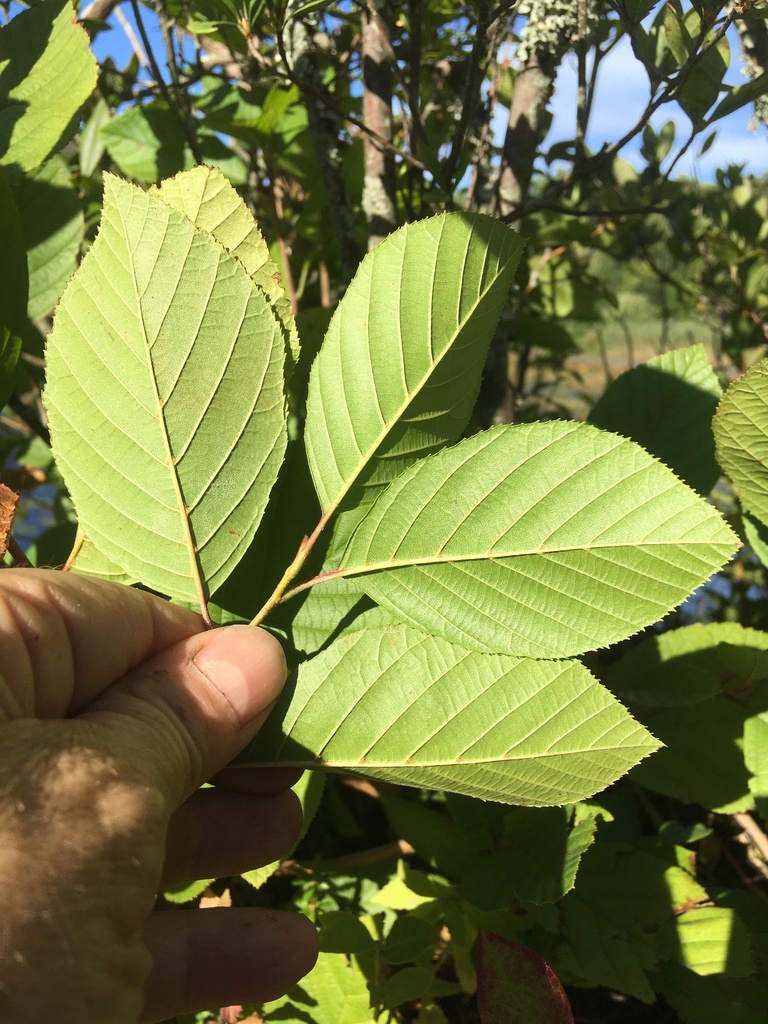
hazel alder
Alnus serrulata
A genus split is not a placement verdict.
Is this one for your yard?
Enter your ZIP to see whether this is legal to plant in your state, and whether it survives your winter.
Yes, hazel alder is rated fire resistant, with several sources calling it low in flammability and one giving it a moderate Firewise rating.
North Carolina extension sources repeatedly rate hazel alder as low flammability. The 2005 assessment uses Low as the favorable result on a four-level scale, while the 2025 assessment places it among 106 low-flammability plants on a three-class scale. A live NC State Extension listing also applies the low-flammability tag.
Oregon State University Extension includes smooth alder among fire-resistant plants suited to Willamette Valley growing conditions. Maryland DNR, New Jersey DEP, and West Virginia Division of Forestry list smooth alder among species with stronger resistance to wildfire ignition. They also describe it as tolerant of wet soils, shade intolerant, and short-lived. The USDA Forest Service and state Firewise programs offer a more qualified judgment: 2 on a four-level scale, labeled “Moderately Firewise,” one step below the strongest Firewise rating. This is a weaker endorsement, but not a warning against the plant.
Hazel alder is a shrub in the birch family that reaches about 10 feet at maturity. Its native range covers the Southeastern, Northeastern, North-Central, and South-Central United States. It needs high water and full sun and is hardy to USDA zone 6a. The repeated low-flammability and fire-resistance findings support calling it fire resistant, while the moderate Firewise result keeps that conclusion appropriately measured.
- Form
- shrub
- Mature height
- ~10 ft
- Light
- Full sun
- Water need
- high
- Rated in
- Maryland, New Jersey, and West Virginia; NC; North Carolina; North Carolina / southeastern US +2