Home / Guides / How to read a record / Which high-desert plants still hold water in June
Which high-desert plants still hold water in June
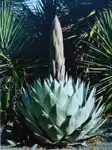
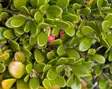
Moisture is the trait AZ1289 leads with. University of Arizona Cooperative Extension AZ1289 (revised December 2011) says a plant’s moisture content is the most important factor governing its volatility, and that drought-adapted plants with succulent leaves that store water are more fire resistant. It also says there are no “fireproof” plant species. Agave parryi is on that shrub table at very-low water. Arctostaphylos uva-ursi is on it at moderate-to-high water, and only at 7,000 feet and up. June in the high desert does not irrigate kinnikinnick into a succulent.
You are at 5,000 feet in June looking at a Parry’s agave and a kinnikinnick tag, both sold as FIREWISE. AZ1289’s elevation columns already split them. This directory’s agave record currently computes as candidate (one lineage). The kinnikinnick record currently computes as on-list. Neither is Zone 0.
This is not an Arizona doorway. Arizona plant evidence combines 453 occurrence records with 69 AZ1289 owners above 3,000 feet and 198 Yavapai County owners. Both source scopes stay regional; neither becomes low-desert statewide guidance.
Why it matters
People hear succulent and plant against the stucco. AZ1289: plant choice, spacing, and maintenance can be more important than what species you use. Resin beats irrigation on pines, firs, spruces, junipers, and Arizona cypress — flammable regardless of moisture status or content. See Cupressus or Hesperocyparis for why that cypress name still lands on one record.
Fire-resistant is not fireproof. AZ1289 prints the same idea.
How it works
AZ1289 is FIREWISE Plant Materials for 3,000 ft. and Higher Elevations (DeGomez, Schalau, Jones, Campbell). Page 5 says it is based on and borrowed heavily from Colorado State Forest Service / CSU FIREWISE Plant Materials (Chuck Dennis) and New Mexico State University. That is a lineage note, not a second independent vote. See the Steward rule.
From the introduction:
- All vegetation is potential fuel. There are no fireproof plant species.
- Moisture content is the most important factor governing volatility.
- Resin can keep a well-watered plant flammable. Named conifers: pines, firs, spruces, junipers, Arizona cypress.
- FIREWISE traits include succulent leaves that store water; high-moisture content (succulents and some herbaceous plants); low resin; open, loose branches.
From the shrub table:
| Taxon | Water needs | Height | Elevation (1,000 ft) |
|---|---|---|---|
| Agave parryi | VL | 2–12 ft | N at 3; Y at 4–8; N at 9 |
| Arctostaphylos uva-ursi | M–H | 1–2 ft | N at 3–6; Y at 7–9 |
Page 5: given Arizona’s arid climate, some listed species have higher water requirements. Work with a county agent.
This directory:
- Agave parryi: one UA AZ1289 recommend row. Computed candidate, limited-evidence. Not on-list.
- Arctostaphylos uva-ursi: on-list, with PNW 590 and other lineages. AZ1289 is not that plant’s only vote.
The paths
| June situation | What AZ1289 is saying | What this site is saying |
|---|---|---|
| Succulent, VL water, 5,000 ft | A. parryi is on the table | Candidate. One lineage. Not Zone 0 |
| Kinnikinnick, M–H water, 5,000 ft | Elevation column is N below 7,000 ft | Do not treat the on-list badge as an AZ1289 elevation match |
| Well-watered juniper or Arizona cypress | Still flammable from oil and pitch | Avoid records stay avoid |
| Drought + rationing | Prioritize water for plants nearest the home (page 4) | Still not a five-foot planting list |
What people mix up
- Succulent as fireproof.
- Irrigation as a resin eraser.
- AZ1289 and CSU 6.305 as two independent votes.
- Limited-evidence agave as on-list.
- Kinnikinnick’s on-list badge as a 5,000-foot, very-low-water plant.
- This page as Yavapai’s list. Yavapai is a separate Arizona lineage; it is not on the agave record.
How to check
- Open AZ1289. Read the moisture paragraph and the two shrub rows.
- Open Agave parryi and Arctostaphylos uva-ursi.
- Open Arizona. Distribution is not a recommendation.
- Check elevation against the AZ1289 columns before you treat a row as local.
- Do not plant in Zone 0.
Limits
This page quotes the opened December 2011 AZ1289 PDF. It does not reprint the tree or grass tables. It does not re-open Yavapai-34. It does not decide a planting. Zone 0 is not a planting list.
Related records
- Agave parryi
- Arctostaphylos uva-ursi
- Arizona plant evidence
- Fire-resistant is not fireproof
- What limited evidence means
Plant records this page rests on
Questions
Does holding water in June make a plant fireproof?
No. AZ1289 states there are no fireproof plant species. Moisture content is the most important factor governing volatility, but resin and other factors keep some species flammable even when well watered. Pines, firs, spruces, junipers, and Arizona cypress tend to be flammable due to oil and pitch, regardless of moisture status.
Why is Agave parryi on the UA list?
AZ1289 lists Agave parryi (mescal/Parry’s agave) as a FIREWISE shrub with very-low water need, 2–12 feet tall, recommended from 4,000 to 8,000 feet. Drought-adapted plants with succulent leaves that store water are named as a fire-resistance trait.
Does kinnikinnick hold water the same way?
AZ1289 lists Arctostaphylos uva-ursi at moderate-to-high water need, 1–2 feet tall, and only at 7,000 to 9,000 feet. Page 5 notes that some listed species have higher water requirements in Arizona’s arid climate. That is not a succulent.
Is Agave parryi on-list here?
No. The record currently computes as candidate, limited-evidence: a single UA AZ1289 recommend row. Limited evidence is not a Zone 0 pass.
Is this an Arizona doorway?
No. The object is moisture versus resin. Place claims sit on whereThisDiffers. The Arizona plant surface keeps 453 occurrence records distinct from the 3,000-foot AZ1289 and Yavapai County regional sources.