Home / Guides / How to read a record / The state flower is an ericaceous fuel
The state flower is an ericaceous fuel
Pennsylvania named Kalmia latifolia the state flower in 1933. DCNR’s viewing page: Governor Gifford Pinchot; peak May–June; tours through Sproul, Bald Eagle, and the rest of the state-forest list. The same department’s wildfire page does not name it. Immediate Zone 0–5 feet: keep this area free of anything that can burn. Long et al. (NIST BFRL whole-plant burns): Kalmia latifolia high. Those four high species should not be planted close to structures. This directory currently computes mountain-laurel as avoid, consensus, and includes PA.
You are on a ridge-and-valley cabin putting the state flower against the foundation because DCNR mapped the bloom. The bloom page is not the 0–5 page. The lab rank is not a viewing tour.
This is not a Pennsylvania doorway. FEIS Kalmia latifolia was blocked this session and is not quoted.
Why it matters
Beloved and native is not on-list. The Pine Barrens page is New Jersey’s CMP distances. What the NC Toolbox rates is AG-874 Table 5 high natives, including mountain laurel. This page is Pennsylvania’s state flower plus DCNR’s 0–5 plus a NIST whole-plant rank.
Zone 0 is still not a planting list. DCNR’s Immediate Zone already says free of anything that can burn.
This site’s Pennsylvania plant evidence currently holds 879 USDA-distribution records (482 on-list, 136 avoid, 45 conflict, 216 candidate). That is occurrence. DCNR did not rate those rows.
How it works
The flower (DCNR viewing page):
- Named state flower 1933, Governor Gifford Pinchot.
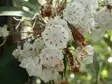
- Native. Star-shaped blooms, pink and white. Peak May–June.
- Viewing list across state forests. No flammability sentence on the opened page.
The house (DCNR wildfire page):
- Debris burning is the No. 1 cause of wildfires in Pennsylvania.
- Most U.S. wildfires occur east of the Mississippi.
- More than half of Pennsylvania ignitions are in the wildland-urban interface: debris burning, outdoor equipment, power lines, campfires.
- Immediate Zone 0–5 feet: free of anything that can burn (mulch, wood piles, dry vegetation).
- Intermediate 5–30. Extended 30–100.
- More detailed guidance: NFPA. No species table.
The lab (Long, Behm, Zipperer, Hermansen, Maranghides, Mell):
- Whole plants, NIST Building and Fire Research Laboratory, large-scale calorimetry. Ignitability, sustainability, combustibility, consumability.
- 34 southern ornamental shrubs. Cluster analysis: 22 low, 8 moderate, 4 high.
- High: Ilex glabra, Ilex vomitoria, Juniperus chinensis, Kalmia latifolia (cultivar Olympic fire).
These four species should not be planted close to structures.
- Moderate can become highly flammable under drought; also not near structures.
This directory’s Kalmia latifolia record:
- Avoid, consensus, PA.
- FPS: NOT Firewise (4), LZ2.
- Long 2006: High flammability (whole-plant burns, NIST BFRL).
- Bardon 2005: High. B921: H, keep out of Zone 1. Virginia Firescapes: H. Toolbox: high (corroboration).
Rhododendron maximum is the neighboring ericaceous mix-up, not this taxon.
The paths
| Claim | Opened source | What it is not |
|---|---|---|
| State flower | DCNR 1933 Pinchot | A foundation listing |
| 0–5 feet, nothing that can burn | DCNR wildfire page | A mountain-laurel exception |
| High at NIST | Long et al., K. latifolia ‘Olympic fire’ | A cultivar exemption for the species record |
| 879 Pennsylvania records | USDA distribution | A DCNR Firewise list |
| NJ CMP mountain laurel | Pine Barrens page | This DCNR tour |
What people mix up
- The viewing map with the 0–5 sentence.
- Native state flower with on-list.
- ‘Olympic fire’ as a lab-only cultivar that leaves the species record untouched. The stored row is the species; the paper named that cultivar.
- New Jersey’s Pine Barrens CMP with Pennsylvania’s DCNR page.
- AG-874 Table 5 as DCNR.
- FEIS (not opened this session) as quoted.
How to check
- Open the DCNR viewing page. Read 1933 and Pinchot.
- Open DCNR wildfire prevention. Read 0–5 feet. Search the page for mountain laurel.
- Open Long et al.. Read the four high species. Read should not be planted close to structures.
- Open Kalmia latifolia. Read
verdictRaw. - Open Pennsylvania plant evidence. Distribution is not a recommendation.
- Do not plant in Zone 0.
Limits
This page quotes opened DCNR HTML (viewing page and wildfire-prevention page) and the opened Long et al. PDF. FEIS Kalmia latifolia returned a block this session and is not quoted. Long et al. tested cultivar ‘Olympic fire’; the stored plant record is the species. 879 is a count of stored USDA-distribution rows as of this writing, not a DCNR statistic. DCNR’s 0–5 / 5–30 / 30–100 bands are NFPA HIZ language on the opened page, not a Pennsylvania plant table. Zone 0 is not a planting list.
Related records
- Kalmia latifolia
- Rhododendron maximum
- Pennsylvania plant evidence
- The Pine Barrens are a fire forest next to the house
- What the NC Toolbox rates that surprises people
- Glossary: Zone 0
Plant records this page rests on
Questions
Is Pennsylvania’s state flower a Firewise foundation plant?
No. DCNR’s mountain-laurel viewing page: native flowers were named the state flower in 1933 by Governor Gifford Pinchot; peak bloom May–June in state forests. DCNR’s wildfire-prevention page does not name mountain laurel. It sets an Immediate Zone (0–5 feet) free of anything that can burn, such as mulch, wood piles, or dry vegetation, and points to NFPA. Long et al. ranked Kalmia latifolia high among 34 southern shrubs in NIST BFRL whole-plant burns and wrote that those four high species should not be planted close to structures. This directory’s Kalmia latifolia currently computes as avoid, consensus, and includes PA.
Does DCNR publish a Firewise plant table?
Not on the opened wildfire-prevention page. Debris burning is the No. 1 cause of wildfires in Pennsylvania. More than half of ignitions occur in the wildland-urban interface. Immediate 0–5, Intermediate 5–30, Extended 30–100. More detailed guidance is on NFPA’s website. This site’s Pennsylvania plant evidence page currently holds 879 USDA-distribution records. Those rows are not a DCNR palette.
Is this the same as New Jersey’s Pine Barrens mountain laurel sentence?
No. The Pine Barrens page is Pinelands CMP 30/75/100 and mountain laurel not as foundation. This page is Pennsylvania’s state flower plus DCNR’s 0–5 band plus the NIST whole-plant rank. Place claims sit on whereThisDiffers.
Is this a Pennsylvania doorway page?
No. The object is a beloved native that lab and lists rank high, next to a state-flower tour. The Pennsylvania plant evidence list is USDA distribution, not this article.