Home / Guides / How to read a record / Juniper or redcedar? The names lie
Juniper or redcedar? The names lie

Cedar is a common name, not a genus. Scher 2002 lists Rocky Mountain juniper (Juniperus scopulorum) under other common names mountain red cedar and Rocky Mountain cedar. Tesky 1992 reviews western redcedar as Thuja plicata. Eastern redcedar, named in the Rocky Mountain juniper review as a hybridizer, is Juniperus virginiana — a juniper. Tell the two genera apart by spray form and cone type. Bark does not distinguish them.
You are looking at a scale-leaf hedge tagged cedar, or at a Firewise PDF that condemns “red cedar” without a Latin name, and trying to match it to one plant page. This site keeps two records. Do not merge them because both tags say cedar. Exhibit ID-001 is the two-panel comparison: one species stands for each genus. It is not a botanical key, and it carries no flammability claim.
Why it matters
A wrong common name applies the wrong evidence stack. Juniperus scopulorum currently computes as avoid. Thuja plicata currently computes as conflict. Identification is not a rating, but mixing the names mixes those stacks. The J. scopulorum record also stores an FPS claim that calls it an upright western native juniper or “red cedar.” Source-verbatim names are how that phrase stays on the juniper, not on the thuja. See source-verbatim names.
Zone 0 is still not a planting list. Naming the hedge does not put it in the first five feet.
How it works
Both reviews are in the cypress family (Cupressaceae). That is the family, not the identification.
Rocky Mountain juniper (Scher 2002, FEIS):
- Leaves scalelike 0.03–0.11 inch (1–3 mm) or needlelike 0.11–0.47 inch (3–12 mm). Adult plants can carry both.
- Ovulate cones, or “berries,” solitary at the tips of branches, fleshy with a resinous pulp.
- Bark thin, fibrous, usually shredding with age.
- Other common names: mountain red cedar, Rocky Mountain cedar.
- Hybridizes with eastern redcedar (J. virginiana).
Western redcedar (Tesky 1992, FEIS):
- Leaves scalelike, flattened, 0.05 to 0.1 inches (1.5–3 mm).
- Twigs flattened, in fanlike sprays and slightly drooping.
- Cones clustered near the ends of twigs and turned up on short stalks.
- Bark thin, fibrous, stringy or shreddy.
- Title common name western redcedar. Other names: western red-cedar, Pacific redcedar, giant redcedar, arborvitae, canoe-cedar, shinglewood, giant arborvitae.
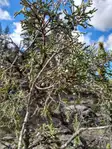
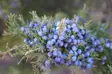
Scale-leaf lengths overlap. That measurement is not the tell. Rounded, three-dimensional sprays with fleshy solitary “berries” versus flattened, fanlike, slightly drooping sprays with small clustered, upturned cones — that is the tell. The exhibit rings those cone clusters. It does not ring the bark.
The directory files eastern redcedar as Juniperus virginiana. This page does not open that species’ FEIS review. Scher’s hybridization note is enough to keep “eastern redcedar” from landing on Thuja.
The paths
| What you opened | What it is not | What to open |
|---|---|---|
| A tag that says cedar, red cedar, or Rocky Mountain cedar | A genus | The Latin name, then the matching plant record |
| Fleshy “berries” solitary at tips of rounded sprays | Thuja plicata | Juniperus scopulorum if that is the species, or another Juniperus record — not the thuja page |
| Flattened fanlike, slightly drooping sprays with small cones clustered and turned up | A juniper | Thuja plicata |
| Shreddy fibrous bark | A diagnostic | Both FEIS reviews describe it. Ignore it for ID |
| “Eastern redcedar” | Western redcedar | Juniperus virginiana, a juniper |
What people mix up
- Treating western redcedar and Rocky Mountain cedar as one plant because both tags say cedar.
- Treating eastern redcedar and western redcedar as one plant because both tags say redcedar.
- Using bark to tell Juniperus from Thuja.
- Using the overlapping scale-leaf millimetre ranges as the tell.
- Reading exhibit ID-001 as a key to every species in either genus. One species stands for each genus, and the sheet says so.
- Reading the exhibit as a flammability rating. Ratings live on the plant records.
- Adding a cypress panel from memory. Cupressus is not on the sheet.
- Merging J. scopulorum with J. monosperma because both are junipers. See when the lab disagrees with the lists.
How to check
- Look at the spray. Rounded and three-dimensional, or flattened, fanlike, and slightly drooping.
- Look at the cones. Fleshy solitary “berries,” or small clustered cones turned up on short stalks.
- Ignore bark. Ignore the word cedar on the tag until you have a Latin name.
- Open Juniperus scopulorum and Thuja plicata. Read the computed status and every evidence row. Do not average them across genera.
- Open Scher 2002 and Tesky 1992 if you want the quotes this page uses.
- Open the Juniperus and Thuja genus hubs. The same exhibit sits there.
- Do not plant in Zone 0 because a tag said cedar, or because it did not.
Limits
This page quotes the opened FEIS botanical descriptions for J. scopulorum and T. plicata. It does not re-open a FEIS review of J. virginiana or of any Cupressus. It does not quote fire-ecology numbers from those reviews as identification facts. It does not rate either plant. Computed statuses on the two records are directory facts, not a new test. Exhibit ID-001 traces public-domain USDA plates (Bulletin 207 Plate IX; Sudworth 1908 Fig. 60) for specimen art; the labeled lengths and cone words are the FEIS quotes. This site does not approve plants. Fire-resistant is not noncombustible.
Related records
- Juniperus scopulorum
- Thuja plicata
- Juniperus virginiana
- Juniperus genus hub
- Thuja genus hub
- Exhibit ID-001
- Source-verbatim names
- When the lab disagrees with the lists
Plant records this page rests on

Questions
Is western redcedar a juniper?
No. FEIS reviews western redcedar as Thuja plicata (Tesky 1992). Rocky Mountain juniper is Juniperus scopulorum, and that review’s other common names include mountain red cedar and Rocky Mountain cedar (Scher 2002). Same family (Cupressaceae). Different genera.
Can I tell them apart by bark?
No. Scher 2002 describes Rocky Mountain juniper bark as thin, fibrous, and usually shredding with age. Tesky 1992 describes western redcedar bark as thin, fibrous, and stringy or shreddy. Exhibit ID-001 labels bark as not distinguishing.
Is eastern redcedar the same as western redcedar?
No. Scher 2002 names eastern redcedar as Juniperus virginiana, a juniper that hybridizes with Rocky Mountain juniper. Western redcedar is Thuja plicata. Two ‘redcedars,’ two genera. This page does not open a FEIS review of J. virginiana; the directory files that species on its own record.
Does identifying the plant decide whether I can keep it near the house?
No. Identification is not a rating. Juniperus scopulorum currently computes as avoid. Thuja plicata currently computes as conflict. Zone 0 is still not a planting list either way.
Does the exhibit cover cypress too?
No. ID-001 is two panels, one species standing for each of two genera. Cupressus is not on the sheet. This page does not invent a third panel.