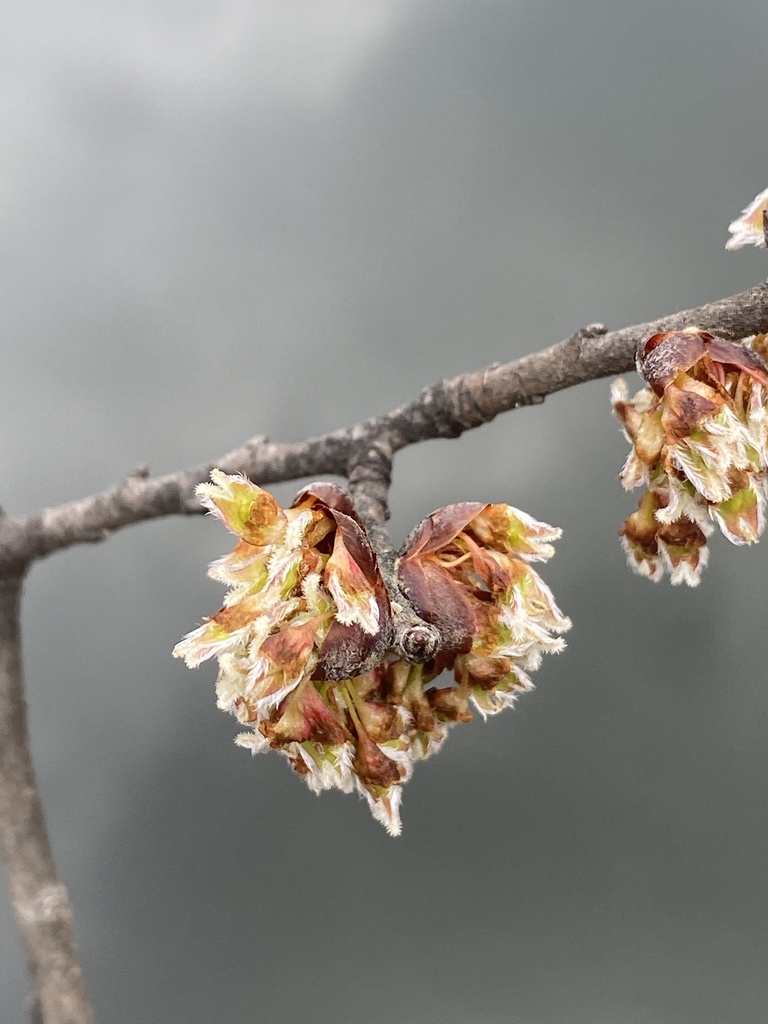
Enter your ZIP to see whether this is legal to plant in your state, and whether it survives your winter.
Elm is rated fire resistant, based on four sources that recommend it for Firewise or defensible-space landscaping.
University of Tennessee Extension lists elm as a Firewise plant. The University of Kentucky Cooperative Extension and Kentucky Division of Forestry name elms among the trees and shrubs that work well in defensible space. The South Carolina Forestry Commission places elm among less-flammable plants with some fire resistance, explaining that less-flammable plants resist fire better than plants that ignite faster and burn readily.
University of Florida IFAS Extension and the Florida Division of Forestry include winged elm in guidance naming less-flammable plants for defensible-space landscaping. Because the source uses that common-name label, the finding supports elm at the genus level rather than providing a separate species rating. Across the four sources, the practical judgment remains consistent even though Tennessee uses a Firewise table, Kentucky gives prose guidance, and Florida and South Carolina organize plants by flammability.
That agreement supports the fire-resistant classification, but the conclusion is appropriately modest: elm is recommended on limited primary evidence. It applies to elm as Ulmus, in the elm family, and should not be expanded into an individual rating for every species. For a homeowner choosing among landscape plants, these sources place elm on the more favorable side of the fire-resistance question.
Form
shrub
Rated in
Florida; Kentucky; South Carolina; Tennessee
On this lot
1. Fire evidence and conditions
Fire evidence
Fire-resistant — location does not change the cited classification.
South Carolina Forestry Commission publishes this explicitly as its Fire Smart Plant List for South Carolina. FireApproved publishes 63 exact genus owners from 72 unique common-name labels; unsafe common-name mappings and duplicates are not broadened. The brochure calls the list non-inclusive and does not establish species-level or site-specific suitability.
University of Kentucky Cooperative Extension and the Kentucky Division of Forestry publish this small-woodland guidance for Kentuckians. FireApproved exposes its 13 exact species or genus owners while retaining the prose-example grain. It is not a scored or comprehensive state table.
University of Tennessee Extension SP685 is Tennessee landscape guidance and publishes 78 represented plant owners. Most table rows are a carrier of Virginia Firescapes rather than an independent rating; Tennessee source scope does not change that lineage or establish site suitability.
2. Why this plant is relevant here
State distribution
Documented in TN.
Native range
Introduced / established
USDA hardiness
3. Legal, ecological, and broader status
Legal-list status
Seed-list status
Reported invasive here
Broader regional context
Federal context
How to read this page
The status above is computed from the cited rows below: independent recommendations can support a fire-resistant result, an avoid row can produce keep-away, and disagreement stays visible as conflict. Placement notes preserve each source’s own scheme rather than translating unlike rules into one scale. This is evidence about a plant, not permission to plant it in every part of the defensible space; Zone 0 remains noncombustible.
Conditions in the fire evidence
These describe tested or rated plant material. They are not horticultural maintenance instructions.
Placement rules below use each source's own distances or named zones, tied to its rating.
They are not interchangeable with the directory's current Zone 0 guidance.
Save Your Home from Wildfire: works well in defensible space [uk-forfs-home] (with its recommendation)
Landscaping in Florida with Fire in Mind: inside defensible space [ufifas-for71-defensible-space] (with its recommendation)
Landscaping Can Be Attractive & FIREWISE: TREES [SCFC Fire Smart plant-form sections] (with its recommendation)
The evidence
Grouped by what each source concluded. Primary evidence rated the plant itself
(a lab, field program, or original curation); corroboration compiled or
republished another source's rating and resolves to its root lineage.