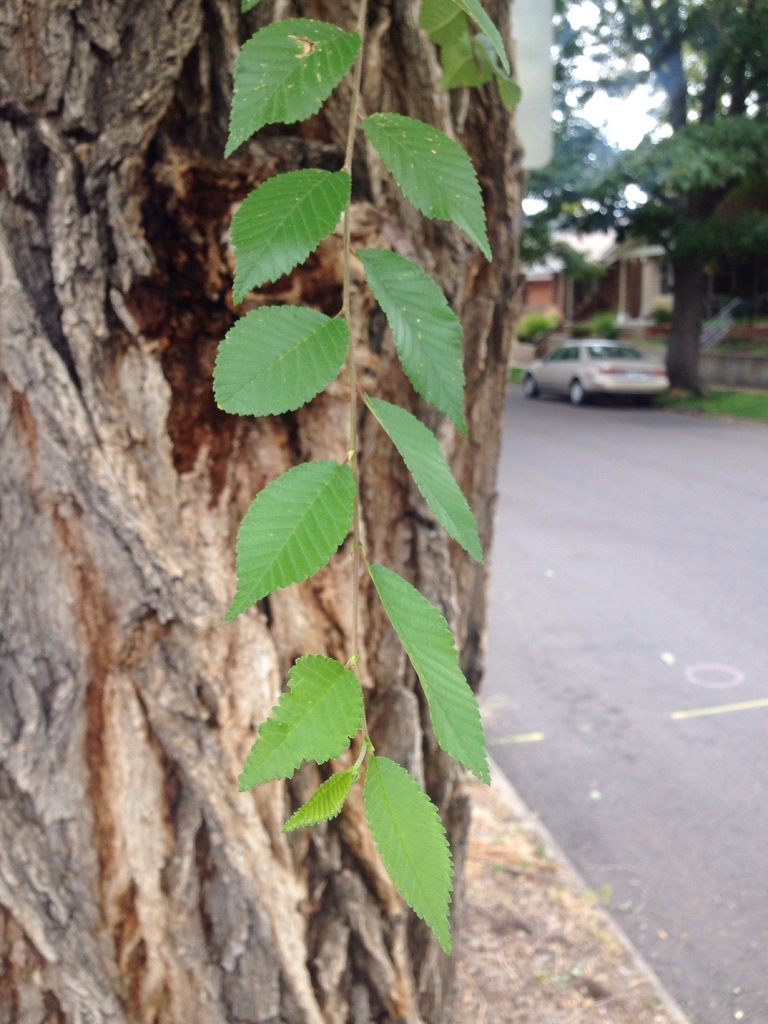
Enter your ZIP to see whether this is legal to plant in your state, and whether it survives your winter.
Siberian elm is generally rated fire resistant, but one Arizona extension source classifies it as fire-prone.
Four of five sources making recommendations favor it. The Forest Service and state Firewise programs give it Firewise 1, the best rating on their four-point scale. Ohio State and Virginia Tech each rate its flammability low, while Valencia’s regional government recommends it for low-flammability gardens.
The disagreement comes from the University of Arizona’s Yavapai County extension service, which places Siberian elm among plants that may ignite readily and burn intensely. These assessments use different scales and address regions ranging from the eastern United States and Midwest to Arizona and Mediterranean Spain. Their conclusions should therefore be read within their stated settings, without treating any one label as universal.
A laboratory measurement adds detail but does not resolve the dispute. Live, unpredried leaves reached flaming at 273°C in an ignition-temperature test. The database preserves that measurement but sets no threshold that turns it into a resistant or fire-prone verdict.
On balance, Siberian elm belongs on the fire-resistant side, though the Arizona warning deserves attention in Yavapai County conditions. It is a roughly 50-foot tree that needs moderate water, and several recommending sources also warn of brittle wood, splitting, or ice-storm damage. Fire rating and structural suitability are separate questions when choosing its place near a home.
Form
tree
Mature height
~50 ft
Light
Full sun
Water need
moderate
Rated in
Global; Ohio / Midwest; Valencia, Spain / western Mediterranean; Virginia / Mid-Atlantic +2
On this lot
1. Fire evidence and conditions
Fire evidence
Fire-resistant — location does not change the cited classification.
Ohio State University Extension Bulletin 921 is an Ohio publication that describes Ohio fire seasons and landscape conditions and labels nativity to Ohio. FireApproved publishes 352 exact source-owning plant records from its eight rated tables. This historical publication scope does not assert current extension endorsement or that a listed plant suits every Ohio site.
Virginia Cooperative Extension's publication opens with Virginia wildfire conditions, identifies its Virginia Firewise Landscaping Task Force, and labels plants native to Virginia. FireApproved publishes 306 exact source owners. Publication scope does not establish parcel suitability or current endorsement of this archived 2009 list.
Yavapai County (AZ footprint); partial normalized coverage · 2025-03-14
University of Arizona Cooperative Extension authors Bulletin 34 for Yavapai County. FireApproved publishes 198 exact source owners from its resistant and prone tables and keeps the county boundary visible. County publication scope is regional Arizona context, never statewide scope.
2. Why this plant is relevant here
State distribution
Documented in AL, AR, AZ, CA, CO, CT, DC, DE, FL, GA, IA, ID, IL, IN, KS, KY, LA, MA, MD, MI, MN, MO, MT, NC, ND, NE, NH, NJ, NM, NV, NY, OH, OK, OR, PA, RI, SD, TN, TX, UT, VA, VT, WA, WI, WV, WY.
Native range
Introduced / established
39 sourced range or established records. This is not an invasive warning.
USDA hardiness
Documented minimum 3a; no upper limit is documented.
3. Legal, ecological, and broader status
Legal-list status
3 legal-list records; the Place chip matches exact scope.
Seed-list status
1 state noxious-weed seed record; the Place chip matches exact scope.
Reported invasive here
1 ecological invasive report.
Broader regional context
Federal context
How to read this page
The status above is computed from the cited rows below: independent recommendations can support a fire-resistant result, an avoid row can produce keep-away, and disagreement stays visible as conflict. Placement notes preserve each source’s own scheme rather than translating unlike rules into one scale. This is evidence about a plant, not permission to plant it in every part of the defensible space; Zone 0 remains noncombustible.
Native and introduced range evidence
These are exact U.S. botanical-area records from the cited range source. Native and
introduced describe biogeographic relationship, not fire performance or planting approval.
Doubtful and extinct rows stay visible but do not count as current presence.
The lossless worldwide derivative is retained once in the research corpus; object pages repeat only exact U.S. areas needed by the local lens. The JSON twin carries the same page assertions.
Plant hardiness evidence
These values describe the plant source. Your ZIP zone comes from the separate 2023 USDA
Plant Hardiness Zone Map. Whole-zone values stay whole-zone, and a single unresolved value
is not treated as a tolerance range. Different source boundaries stay separate: overlapping
statements are compared independently, while only ranges with no shared zone are called a conflict.
Source prints 4 · single-value meaning unresolved · whole zone precision · source stated
Source taxon: Ulmus pumila · exact match.
Source location: Cold Hardiness Zone field in the recovered selector record.
Not used for comparison: The recovered selector prints one Cold Hardiness Zone value but does not define it as a minimum threshold or a one-zone range.
Source location: PlantCharacteristics record 71003, Temperature, Minimum (°F).
Where its sources say to plant it
Placement rules below use each source's own distances or named zones, tied to its rating.
They are not interchangeable with the directory's current Zone 0 guidance.
Eastern United States Fire Performance Plant Selector: Landscape Zone 3 — 10–30 ft from the structure; thin vegetation, remove debris, and minimize plant massing [Fire Performance Plant Selector landscape zone] (with its recommendation)
The evidence
Grouped by what each source concluded. Primary evidence rated the plant itself
(a lab, field program, or original curation); corroboration compiled or
republished another source's rating and resolves to its root lineage.
Listed as Siberian Elm — Ulmus pumila. The bulletin says fire-resistant plants tend to resist ignition when irrigated and maintained, while fire-prone plants may ignite readily and burn intensely.
Listed without a rating (3)Corroboration (3 rows from 1 source)
3 cited rows from this source; its identity, lineage and tier are stated once.
Primary study Shan2008: Shan, Y., Liu, N., & Shu, L. (2008). Flammability ranking of foliage species by factor analysis of physical and chemical pyric properties. Fire and Materials: An International Journal, 32, 371-382.
Shared row context: plant part leaves; fuel live; predrying no; site Shan2008-1; sampling ND.
“temperature at flaming (°C): 273”
FLAMITS record 12564; Ignitability measurement; device ignition temperature tester.
“calorific value (kcal/kg): 4651.76”
FLAMITS record 12565; Combustibility measurement; device calorimeter.
“calorific value (kcal/kg): 4255.27”
FLAMITS record 13725; Combustibility measurement; plant part leaves; fuel live; predrying yes; device calorimeter; site Wang2009-1; sampling november. Primary study Wang2009: Wang, X., Niu, S., & Kan, Z. (2009). Properties and flammability of major tree species in the Beijing area. Frontiers of Forestry in China, 4, 304-308.