Enter your ZIP to see whether this is legal to plant in your state, and whether it survives your winter.
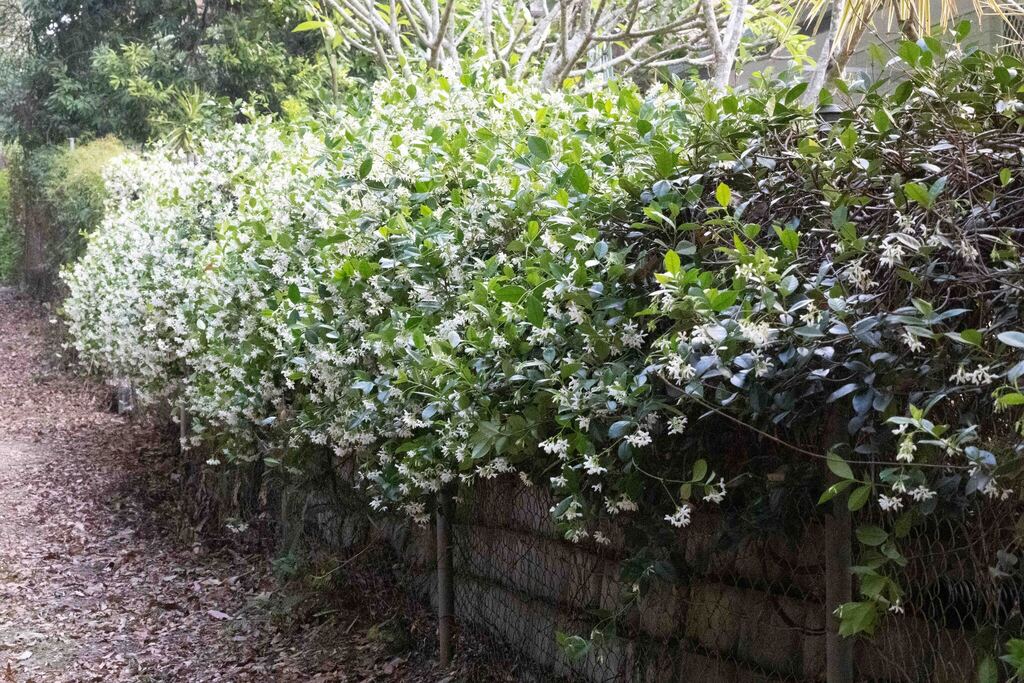
Confederate jasmine is generally rated fire resistant, but Travis County warns against using it within 30 feet of a structure.
Five of six sources favor the vine. Fire and Emergency New Zealand places it in the low-moderate band of a seven-level classification grounded in shoot-flammability testing. The Diputació de Girona and Catalonia’s fire service recommend confederate jasmine for gardens, assuming species-specific care. Fire Safe Marin’s fire-resistant selection includes the vine; placement, spacing, irrigation, and removal of dead material remain necessary.
Two California compilations also favor confederate jasmine. The University of California Forest Products Laboratory reported that eight earlier references recommended it for high-fire-risk areas, but flagged two weaknesses in the underlying lists: undefined terms and frequent lack of a scientific basis. Eight references support confederate jasmine’s placement in the Diablo Firesafe Council’s favorable fire-performance table.
Texas A&M AgriLife Extension in Travis County takes the opposing position. It restricts confederate jasmine to zones 2 or 3 and warns against the vine in Zone 1, within 30 feet of a structure. The sources use different methods and address different regions, and their disagreement remains unresolved. The overall balance supports calling confederate jasmine fire resistant, but its Travis County placement warning should be followed there.
Form
vine
Mature height
~35 ft
Light
Full sun
Water need
moderate
Rated in
Austin, Texas; California; Catalonia, Spain; Global +3
On this lot
1. Fire evidence and conditions
Fire evidence
Fire-resistant — location does not change the cited classification.
The guide presents itself as fire performance ratings for common landscape plants in a fire-prone California setting. FireApproved publishes 104 exact owners as republished California context. It is not an independent rating, a current endorsement, or parcel suitability.
Marin County (CA footprint); partial normalized coverage · 2019-01-01
The publication is explicitly limited to plants common to Marin County. FireApproved publishes 104 exact owners as Marin regional context while retaining its placement, spacing, irrigation, and maintenance boundary. It is not statewide California guidance or parcel suitability.
The UC Forest Products Laboratory says the guide covers properties of common California landscaping plants and was prepared for California fire agencies. FireApproved publishes 130 exact owners at historical California publication scope. The report is a 1997 compilation, not a current endorsement, site rating, or independent test of every row.
Travis County, Austin area (TX footprint); partial normalized coverage · 2024-01-16
Texas A&M AgriLife Extension publishes this page through its Travis County horticulture program. FireApproved publishes 56 exact owners and retains the source's zone and warning conditions. This is county/Austin regional context, not a second statewide Texas table or site clearance.
2. Why this plant is relevant here
State distribution
Documented in DC, DE, FL, LA, MD, NJ, OH, PA, TX, WV.
Native range
Introduced / established
3 sourced range or established records. This is not an invasive warning.
USDA hardiness
Documented minimum 7b; no upper limit is documented.
3. Legal, ecological, and broader status
Legal-list status
Seed-list status
Reported invasive here
1 ecological invasive report.
Broader regional context
Federal context
How to read this page
The status above is computed from the cited rows below: independent recommendations can support a fire-resistant result, an avoid row can produce keep-away, and disagreement stays visible as conflict. Placement notes preserve each source’s own scheme rather than translating unlike rules into one scale. This is evidence about a plant, not permission to plant it in every part of the defensible space; Zone 0 remains noncombustible.
Native and introduced range evidence
These are exact U.S. botanical-area records from the cited range source. Native and
introduced describe biogeographic relationship, not fire performance or planting approval.
Doubtful and extinct rows stay visible but do not count as current presence.
The lossless worldwide derivative is retained once in the research corpus; object pages repeat only exact U.S. areas needed by the local lens. The JSON twin carries the same page assertions.
Plant hardiness evidence
These values describe the plant source. Your ZIP zone comes from the separate 2023 USDA
Plant Hardiness Zone Map. Whole-zone values stay whole-zone, and a single unresolved value
is not treated as a tolerance range. Different source boundaries stay separate: overlapping
statements are compared independently, while only ranges with no shared zone are called a conflict.
Source location: Cold Hardiness Zone field in the recovered selector record.
Not used for comparison: The recovered selector prints one Cold Hardiness Zone value but does not define it as a minimum threshold or a one-zone range.
Placement rules below use each source's own distances or named zones, tied to its rating.
They are not interchangeable with the directory's current Zone 0 guidance.
Eastern United States Fire Performance Plant Selector: Landscape Zone 2 — 5–10 ft from the structure; maintained lawn or fuel breaks, with easily ignited evergreens avoided [Fire Performance Plant Selector landscape zone] (mid-scale rating)
Guía de pirojardinería: suitable inside or outside the 25-metre maximum-risk zone [girona-2020-iuf-25m-suitability] (with its recommendation)
Defensible Space Landscaping in the Urban/Wildland Interf…: Chapter 4, Landscape Vegetation Database [ucfpl-1997] (with its recommendation)
Firewise Landscaping: Vines [Travis County Firewise page sections] (with its avoid rating)
Fire Performance of Common Plants: Table 1 (favorable in 3 or more references) [diablo-guide-to-plants-three-reference-vote] (with its recommendation)
The evidence
Grouped by what each source concluded. Primary evidence rated the plant itself
(a lab, field program, or original curation); corroboration compiled or
republished another source's rating and resolves to its root lineage.
Recommends (5)
Low Flammability Plants directory — Fire and Emergency New Zealand (plant flammability testing at Lincoln University) · 2026 · original sourcePrimary evidenceLab-testedlineage: lincoln-nz-tree
Trachelospermum jasminoides is rated “RECOMENDADA” by the guide's qualitative IUF garden-suitability method. The method assumes species-specific care and integrates fire evidence with fuel structure, maintenance, origin, invasiveness, and expert fire-service experience.
Fire Performance of Common Plants (Guide to Plants) — Diablo Firesafe Council · live page captured 2026-08-29 · original sourceCorroborationMirrorlineage: ucfpl-berkeley resolves to Defensible Space Landscaping in the Urban/Wildland Interface: A Compilation of Fire Performance Ratings of Residential Landscape Plants
“Table 1: favorable fire performance rating in 3 or more references (refs 9,11,12,17,25,40,41,53)”
The Diablo Firesafe Council Guide to Plants lists Trachelospermum jasminoides (Star jasmine) as groundcover, evergreen, in Table 1: plants with a favorable fire performance rating in 3 or more references. The guide cites 8 of its 57 numbered references for this row (9,11,12,17,25,40,41,53). The guide states the ranking terms in its underlying references were mostly undefined and makes no attempt to rank within the list, and that fire performance is compromised without maintenance.
“Plants to Avoid for Zone 1 (within 30′ of Structure)”
Listed as Jasmine, Confederate — Trachelospermum jasminoides. The page says Zone 1 entries should be restricted to zones 2 or 3; all-zone entries are highly flammable due to volatile oils or growth habit.
8 cited rows from this source; its identity, lineage and tier are stated once.
Primary study Cui2020a: Cui, X., Paterson, A. M., Wyse, S. V., Alam, M. A., Maurin, K. J. L., Pieper, R., ... Curran, T. J. (2020a). Shoot flammability of vascular plants is phylogenetically conserved and related to habitat fire-proneness and growth form. Nature Plants, 6, 355-359.
Shared row context: plant part branches; fuel all; predrying yes; device grill; site Cui2020a-1; sampling ND.
“ignition frequency (%): 33.3”
FLAMITS record 1506; Ignitability measurement.
“maximum sample temperature (°C): 227.7”
FLAMITS record 1700; Combustibility measurement.
“burning duration (s): 2.2”
FLAMITS record 1894; Sustainability measurement.
“estimated burnt biomass (%): 5.8”
FLAMITS record 2088; Consumability measurement.
Primary study Murray2023: Murray, B. R., Hawthorne, T., Curran, T. J., Krix, D. W., Wallace, M. I., Young, K., ... & Webb, J. K. (2023). Shoot flammability patterns among plant species of the wildlandurban interface in the fire-prone Greater Blue Mountains World Heritage Area. International Journal of Wildland Fire, Online early.
Shared row context: plant part branches; fuel all; predrying yes; device grill; site Murray2023-1; sampling ND.