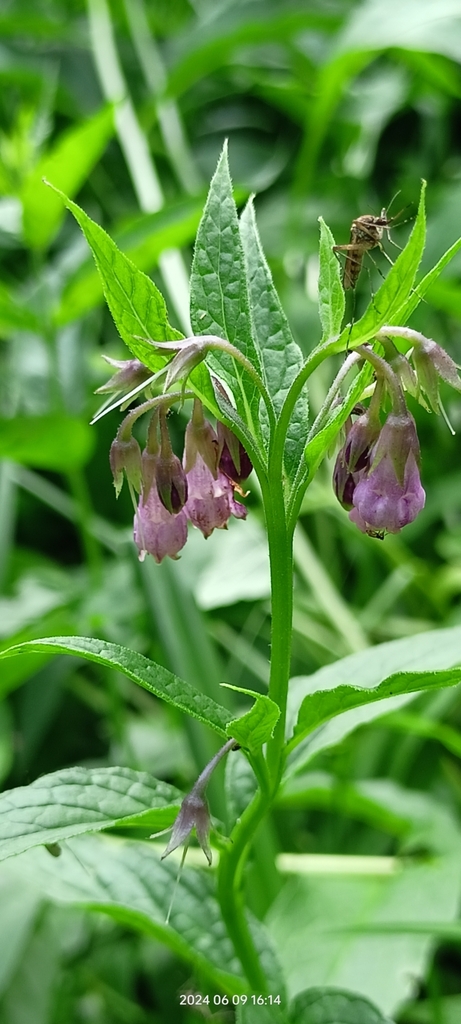
Enter your ZIP to see whether this is legal to plant in your state, and whether it survives your winter.
Yes, common comfrey is rated fire resistant, based on two favorable sources and limited primary evidence.
Fire and Emergency New Zealand classifies common comfrey as having very low flammability, the lowest flammability band on its seven-level scale. That classification is grounded in shoot-flammability testing. The University of Arizona Cooperative Extension includes common comfrey in its fire-resistant list: with irrigation and maintenance, these plants tend to resist ignition, but they are not fireproof.
Dryad’s FLAMITS database contributes a measurement rather than a recommendation. Predried common comfrey branches tested on a grill reached a maximum flame temperature of 667.98°C. This number reports the hottest flame observed under that experimental setup. FLAMITS combines measurements from different plant parts, devices, and aspects of flammability without imposing a single threshold that separates resistant from fire-prone plants. The temperature therefore adds detail about combustion but does not change the two favorable classifications.
Common comfrey is a perennial in the Boraginaceae family. It has been introduced in 33 states, including Arkansas, California, and Colorado, and has been flagged as invasive in two jurisdictions. The New Zealand directory also flags it as poisonous. Those concerns do not alter its flammability classification, but they do mean that a fire-resistant rating alone is not a complete reason to choose it for a landscape.
Form
perennial
Rated in
Global; New Zealand; Yavapai County, Arizona
On this lot
1. Fire evidence and conditions
Fire evidence
Fire-resistant — location does not change the cited classification.
Fire-performance conditions
Fire ecology context
Placement evidence
Evidence regions
Global; New Zealand; Yavapai County, Arizona
Maintenance
Typed publication scope: 1 scope across 1 cited fire source
Yavapai County (AZ footprint); partial normalized coverage · 2025-03-14
University of Arizona Cooperative Extension authors Bulletin 34 for Yavapai County. FireApproved publishes 198 exact source owners from its resistant and prone tables and keeps the county boundary visible. County publication scope is regional Arizona context, never statewide scope.
2. Why this plant is relevant here
State distribution
Documented in AR, CA, CO, CT, DC, DE, GA, ID, IL, IN, KY, MA, MD, ME, MI, MN, MO, MT, NC, NH, NJ, NM, NY, OH, OR, PA, RI, TN, UT, VA, VT, WA, WI, WV, WY.
Native range
Introduced / established
34 sourced range or established records. This is not an invasive warning.
USDA hardiness
3. Legal, ecological, and broader status
Legal-list status
Seed-list status
Reported invasive here
2 ecological invasive reports.
Broader regional context
Federal context
How to read this page
The status above is computed from the cited rows below: independent recommendations can support a fire-resistant result, an avoid row can produce keep-away, and disagreement stays visible as conflict. Placement notes preserve each source’s own scheme rather than translating unlike rules into one scale. This is evidence about a plant, not permission to plant it in every part of the defensible space; Zone 0 remains noncombustible.
Native and introduced range evidence
These are exact U.S. botanical-area records from the cited range source. Native and
introduced describe biogeographic relationship, not fire performance or planting approval.
Doubtful and extinct rows stay visible but do not count as current presence.
The lossless worldwide derivative is retained once in the research corpus; object pages repeat only exact U.S. areas needed by the local lens. The JSON twin carries the same page assertions.
The evidence
Grouped by what each source concluded. Primary evidence rated the plant itself
(a lab, field program, or original curation); corroboration compiled or
republished another source's rating and resolves to its root lineage.
Recommends (2)
Low Flammability Plants directory — Fire and Emergency New Zealand (plant flammability testing at Lincoln University) · 2026 · original sourcePrimary evidenceLab-testedlineage: lincoln-nz-tree
“Very low flammability”
Very low flammability classification. Flagged poisonous in the FENZ directory.
Listed as Comfrey — Symphytum officinale. The bulletin says fire-resistant plants tend to resist ignition when irrigated and maintained, while fire-prone plants may ignite readily and burn intensely.
Listed without a rating (3)Corroboration (3 rows from 1 source)
3 cited rows from this source; its identity, lineage and tier are stated once.
Primary study Pacheco2022: Pacheco, A. S., Goodman, H. D., Hankenson, L., Fisk, J. J., Ortiz, A., Marinace, H. M., ... Tng, D. Y. P. (2022). Fighting fire with food: Assessing the flammability of crop plant species for building fire resilient agroforestry systems. in review, preprint.
Shared row context: plant part branches; fuel all; predrying yes; device grill; site Pacheco2022-1; sampling october to november 2022.