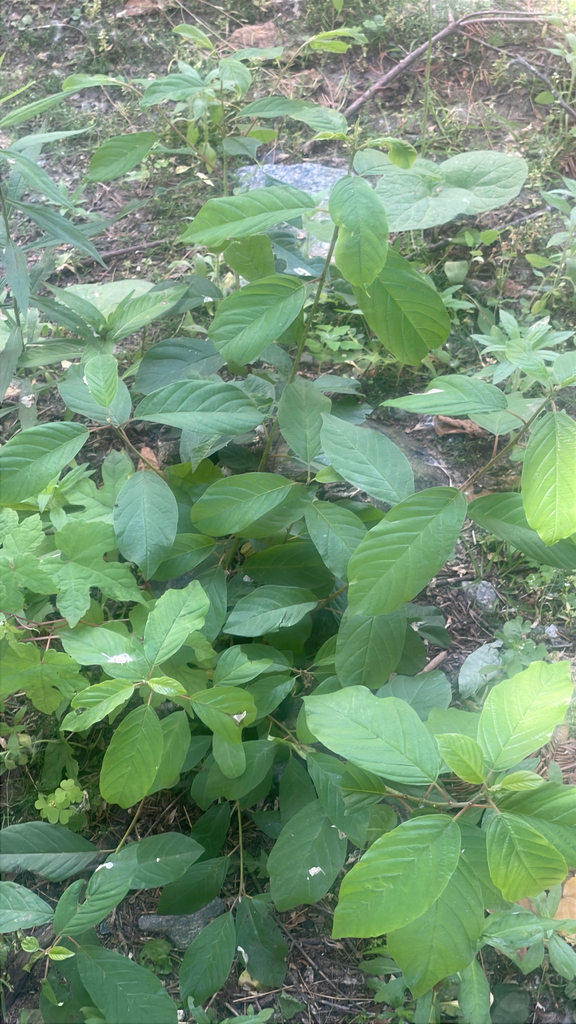
Photo: no rights reserved (CC0),
via iNaturalist. Species-typical, not necessarily this cultivar.
glossy buckthorn
Rhamnus frangula (accepted: Frangula alnus) · Rhamnaceae · all Rhamnus records · also called 'Fine Line® Improved' buckthorn · syn. Rhamnus frangula · Wikipedia
The Place chip compares this record with your lot.
Enter your ZIP to see whether this is legal to plant in your state, and whether it survives your winter.
Yes, glossy buckthorn is rated fire resistant, with all six published assessments pointing in the same direction.
Extension services from Oregon State, Washington State and the University of Idaho list it as fire resistant, as do Washington’s Department of Natural Resources and FireSmart BC. Ohio State places it in the low band of its five-point flammability scale, which is one of the two bands that service recommends. Oregon State also includes the shrub among fire-resistant plants suited to Willamette Valley growing conditions.
The laboratory evidence supports those recommendations from a different angle. Conditioned glossy buckthorn foliage and twigs, tested at 25 kilowatts per square metre in a cone calorimeter, fell within the study authors’ low effective-heat-of-combustion group. That measurement concerns the heat material releases during combustion; it does not by itself recreate the behaviour of a mature shrub in a garden fire.
Glossy buckthorn is a roughly 12-foot shrub requiring moderate water and suited to USDA zones 2a through 7b. Its fire rating is consistently favourable across expert plant lists, a graded flammability system and a laboratory study. Fire resistance is not its only consideration, however: one jurisdiction flags the species as invasive, so its local regulatory status should be checked before planting.
Form
shrub
Mature height
~12 ft
Water need
moderate
Rated in
British Columbia; OR/WA/ID; Ohio / Midwest; Oregon (Willamette Valley) +4
On this lot
1. Fire evidence and conditions
Fire evidence
Fire-resistant — location does not change the cited classification.
Northeastern and mid-Atlantic study sites (ME, MD, MA, NY, VA footprint); partial normalized coverage · 2007-08-20
The authors collected foliage and twigs across study sites in Maine, Maryland, Massachusetts, New York, and Virginia, then conditioned and tested the samples in a cone calorimeter. FireApproved publishes 37 exact source owners only as multi-state laboratory context. The source does not establish that every taxon was sampled in every named state, whole-plant behavior, landscape suitability, or state planting guidance.
Southern Idaho (ID footprint); partial normalized coverage · 2013-11-08
The official database labels itself "For Southern Idaho" and describes Idaho residents at the urban-rangeland interface. FireApproved publishes 419 existing plant owners that cite its scored rows. This bounded Southern Idaho scope is regional context, not statewide coverage or a conclusion that the score transfers unchanged to every Idaho site.
Ohio State University Extension Bulletin 921 is an Ohio publication that describes Ohio fire seasons and landscape conditions and labels nativity to Ohio. FireApproved publishes 352 exact source-owning plant records from its eight rated tables. This historical publication scope does not assert current extension endorsement or that a listed plant suits every Ohio site.
Willamette Valley (OR footprint); partial normalized coverage · 2015-02-01
OSU Extension says EM 9103 highlights fire-resistant plants that thrive under Willamette Valley growing conditions. FireApproved publishes 172 exact owners only as valley context. The guide shares the PNW 590 lineage and is not a second independent vote or statewide site clearance.
The October 2023 joint Pacific Northwest Extension publication explicitly names Oregon, Washington, and Idaho and publishes more than 150 plant profiles. FireApproved has normalized 155 exact plant records from the source; publication scope does not assert that every listed plant suits every site within the three states.
Eastern Washington (WA footprint); partial normalized coverage
Washington DNR publishes the guide for Eastern Washington and says it compiles plants from other Firewise documents that are likely to thrive there. FireApproved publishes 46 exact owners only as eastern Washington context. The rows are corroborative, not empirical or statewide.
2. Why this plant is relevant here
State distribution
Documented in CO, CT, IA, ID, IL, IN, KY, MA, MD, ME, MI, MN, NC, NE, NH, NJ, NY, OH, OR, PA, RI, TN, VT, WA, WI, WV, WY.
Native range
Introduced / established
USDA hardiness
3 applicable cited hardiness statements overlap but have different boundaries; compare each complete source row.
3. Legal, ecological, and broader status
Legal-list status
Seed-list status
Reported invasive here
Broader regional context
Federal context
How to read this page
The status above is computed from the cited rows below: independent recommendations can support a fire-resistant result, an avoid row can produce keep-away, and disagreement stays visible as conflict. Placement notes preserve each source’s own scheme rather than translating unlike rules into one scale. This is evidence about a plant, not permission to plant it in every part of the defensible space; Zone 0 remains noncombustible.
Plant hardiness evidence
These values describe the plant source. Your ZIP zone comes from the separate 2023 USDA
Plant Hardiness Zone Map. Whole-zone values stay whole-zone, and a single unresolved value
is not treated as a tolerance range. Different source boundaries stay separate: overlapping
statements are compared independently, while only ranges with no shared zone are called a conflict.
Placement rules below use each source's own distances or named zones, tied to its rating.
They are not interchangeable with the directory's current Zone 0 guidance.
Eastern United States Fire Performance Plant Selector: Landscape Zone 3 — 10–30 ft from the structure; thin vegetation, remove debris, and minimize plant massing [Fire Performance Plant Selector landscape zone] (mid-scale rating)
Fire Resistance of Plants Master Database: plantable at 50' from home [Idaho minimum planting distance] (mid-scale rating)
FireSmart BC Plant Program: suitable for HIZ extended zone (30-100 m) [FireSmart BC Home Ignition Zone] (with its recommendation)
Fire-resistant Landscape Plants for the Willamette Valley: Alder Buckthorn profile (PDF page 108) [osu-em-9103-profile] (with its recommendation)
The evidence
Grouped by what each source concluded. Primary evidence rated the plant itself
(a lab, field program, or original curation); corroboration compiled or
republished another source's rating and resolves to its root lineage.