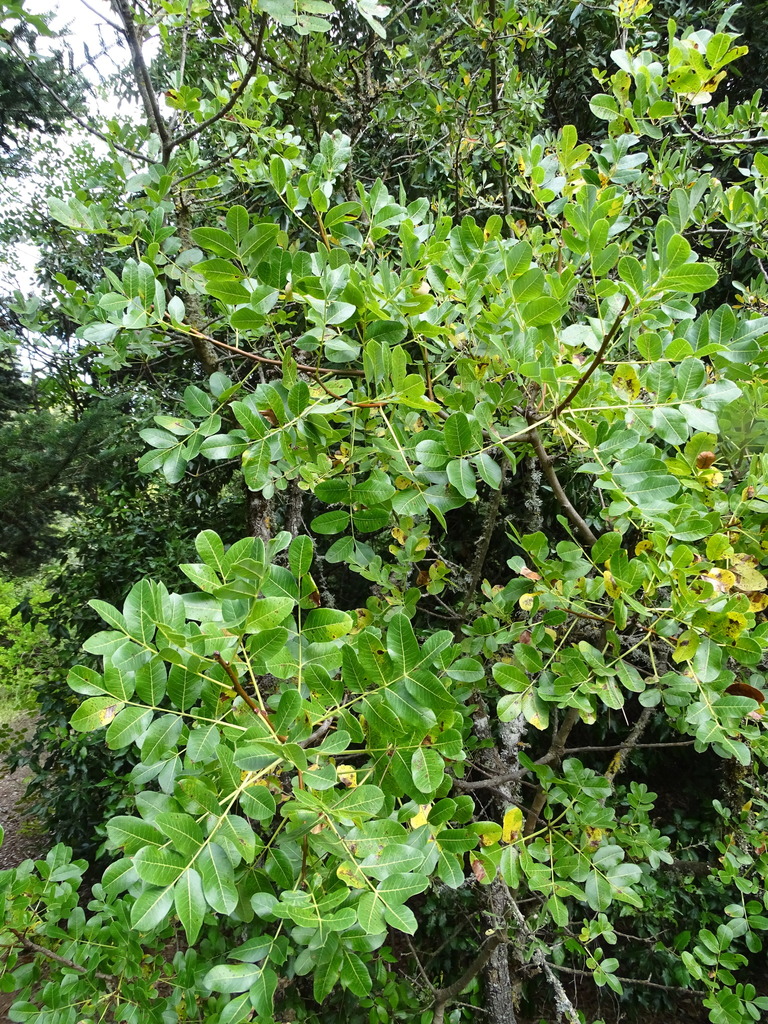
Enter your ZIP to see whether this is legal to plant in your state, and whether it survives your winter.
Cyprus turpentine is rated fire resistant, with four Mediterranean authorities recommending it for fire-conscious planting.
Valencia’s regional government names the shrub as a recommended low-flammability species for wildland-urban-interface gardens. Girona’s provincial government and Catalonia’s fire service rate it “very recommended” for garden suitability, assuming care suited to the species. Origin and invasiveness also enter that judgment, as do maintenance, fuel structure, fire research, and fire-service experience. Barcelona’s provincial government and CREAF likewise say to retain Cyprus turpentine first among less-flammable species when creating and maintaining perimeter protection strips. Turkey’s forestry authority also names it for preservation, encouragement, or use in fire-resistant or slow-burning forest and fire-prevention plantings. Together, these recommendations give the shrub a consistent practical verdict across several regional systems.
A laboratory observation adds context but does not create the verdict by itself. Live, un-dried leaves collected from July through August took 13.45 seconds to produce flames under an epiradiator ignitability test. That figure describes one plant part under one experimental setup; the database that preserves it does not impose a universal threshold for calling plants resistant or flammable.
They repeatedly place Cyprus turpentine among lower-flammability or fire-prevention choices, although Girona’s broad method also considers factors beyond combustion alone.
Form
shrub
Region
Italy; Turkey; Valencia, Spain
Rated in
Catalonia, Spain; Global; Turkey; Valencia, Spain / western Mediterranean
On this lot
1. Fire evidence and conditions
Fire evidence
Fire-resistant — location does not change the cited classification.
Catalonia, Spain; Global; Turkey; Valencia, Spain / western Mediterranean
Maintenance
2. Why this plant is relevant here
State distribution
Native range
Introduced / established
USDA hardiness
3. Legal, ecological, and broader status
Legal-list status
Seed-list status
Reported invasive here
Broader regional context
Federal context
How to read this page
The status above is computed from the cited rows below: independent recommendations can support a fire-resistant result, an avoid row can produce keep-away, and disagreement stays visible as conflict. Placement notes preserve each source’s own scheme rather than translating unlike rules into one scale. This is evidence about a plant, not permission to plant it in every part of the defensible space; Zone 0 remains noncombustible.
Where its sources say to plant it
Placement rules below use each source's own distances or named zones, tied to its rating.
They are not interchangeable with the directory's current Zone 0 guidance.
Guía de pirojardinería: suitable inside or outside the 25-metre maximum-risk zone [girona-2020-iuf-25m-suitability] (with its recommendation)
Les franges perimetrals de protecció contra els incendis …: page 4 species-selection panel [catalonia-perimeter-strip-maintain-remove] (with its recommendation)
Yanan Orman Alanlarının Rehabilitasyonu ve Yangına Direnç…: Yangın önleyici tesisler; Dere vejetasyonlarının korunması [yardop-6976-operational-fire-resistant-planting] (with its recommendation)
The evidence
Grouped by what each source concluded. Primary evidence rated the plant itself
(a lab, field program, or original curation); corroboration compiled or
republished another source's rating and resolves to its root lineage.
Pistacia terebinthus is rated “MUY RECOMENDADA” by the guide's qualitative IUF garden-suitability method. The method assumes species-specific care and integrates fire evidence with fuel structure, maintenance, origin, invasiveness, and expert fire-service experience.
“Cal mantenir prioritàriament les espècies menys inflamables. — Noguerola — Pistacia terebintus”
The guide says to maintain this printed taxon first among the less-flammable species when opening and maintaining perimeter protection strips. Printed-name correction used for exact matching: Pistacia terebintus -> Pistacia terebinthus.
“güç yanan ve rüzgar perdesi oluşturan otsu veya odunsu bitkilerden — menengiç”
The YARDOP circular directs managers to preserve, encourage, or use this named taxon in fire-resistant or slow-burning forest and fire-prevention plantings.
Listed without a rating (9)Corroboration (9 rows from 1 source)
9 cited rows from this source; its identity, lineage and tier are stated once.
Primary study Petriccione2006: Petriccione, M. (2006). Infiammabilità della lettiera di diverse specie vegetali di ambiente mediterráneo. Tesi Di Dottorato. Università Degli Studi Di Napoli Federico II.
Shared row context: plant part leaves; fuel live; predrying no; device epiradiator; site Petriccione2006-1; sampling july to august.
Primary study Guney2022: Güney, C. O., Sar?, A., Cekim, H. O., Küçüksille, E. U., ?entürk, Ö., Gülsoy, S., & Özkan, K. (2022). An advanced approach for leaf flammability index estimation. International journal of wildland fire, 31, 277-290.
Shared row context: plant part leaves; fuel live; predrying no; device calorimeter; site Guney2022-1; sampling may and september 2017.