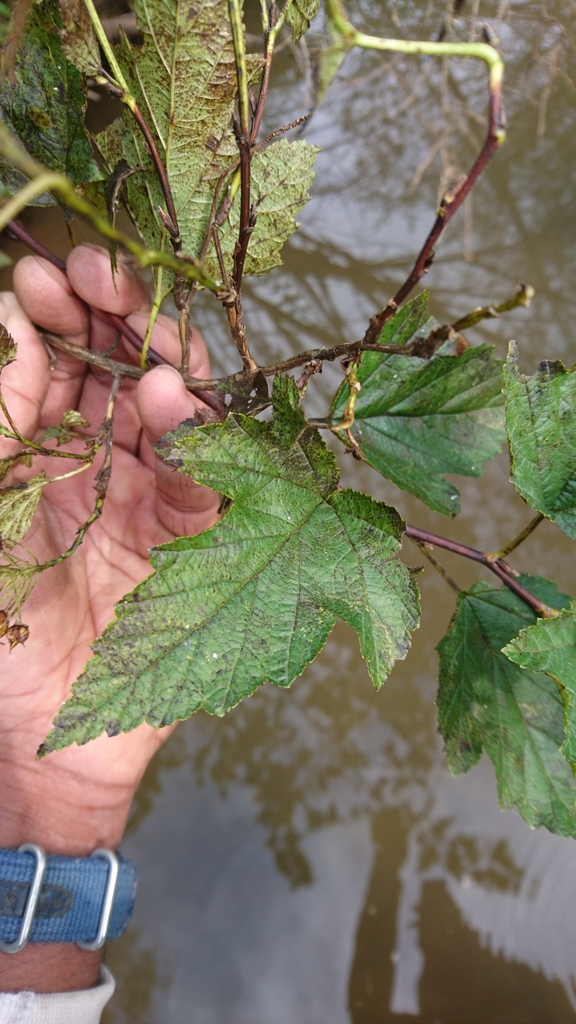
common ninebark
Physocarpus opulifolius
A genus split is not a placement verdict.
Is this one for your yard?
Enter your ZIP to see whether this is legal to plant in your state, and whether it survives your winter.
Common ninebark is best treated as fire resistant, although one prominent plant selector rates it Not Firewise.
Five of six sources favor the shrub.
Ohio State University Extension gives common ninebark an “L” on its five-band flammability scale, which supports recommending it. Virginia Cooperative Extension also gives it an “L,” the favorable rating on its three-point scale. Wisconsin DNR and UW-Extension feature it as a Firewise plant, FireSmart BC approves it as fire resistant, and the University of Tennessee Extension lists it among Firewise plants.
The USDA Forest Service Northeastern Area and state Firewise programs reach the opposite conclusion. Their selector assigns common ninebark “Not Firewise,” the least favorable category on its four-level scale, and also notes exfoliating orange bark in winter. The sources use different kinds of judgments: Ohio and Virginia apply graded flammability scales, while Wisconsin, British Columbia, and Tennessee use plant profiles or approved-plant lists. Those labels are not exact equivalents, but the unfavorable finding remains a genuine caution within an otherwise favorable balance.
Full sun and low water suit common ninebark, a shrub that reaches about 10 feet at maturity and belongs to the rose family. It is hardy to USDA zone 5a. Taken together, the findings support calling it fire resistant without presenting that conclusion as unanimous.
- Form
- shrub
- Mature height
- ~10 ft
- Light
- Full sun
- Water need
- low
- Rated in
- British Columbia; Catalonia, Spain; Global; Maryland, New Jersey, and West Virginia +7