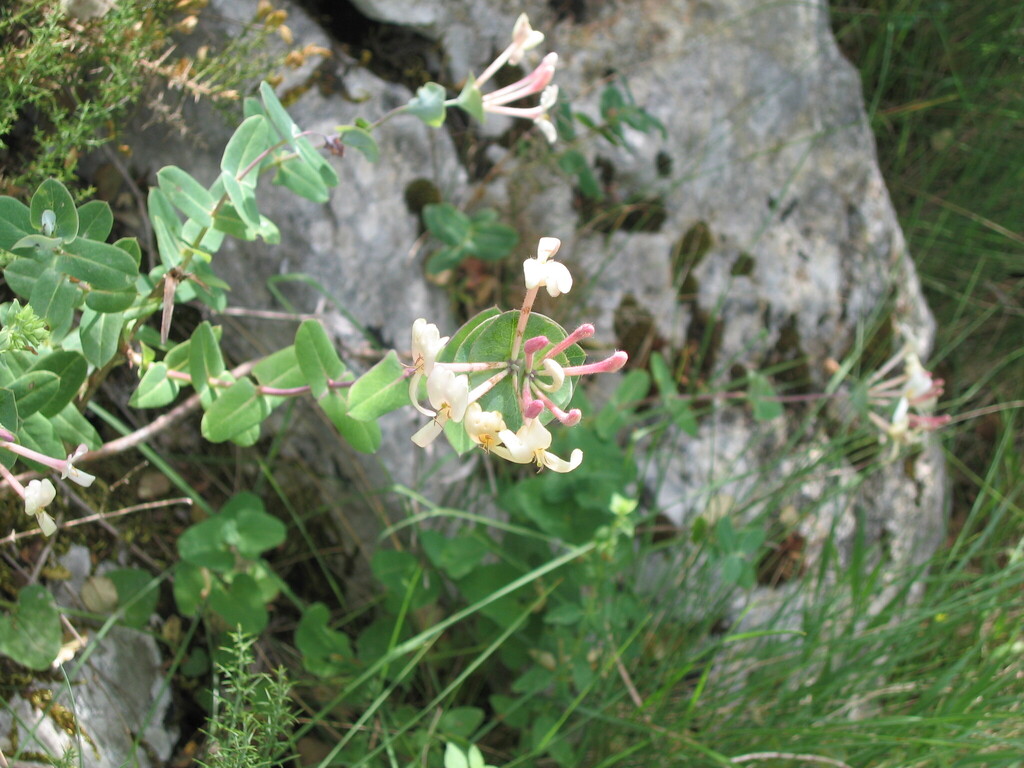
Enter your ZIP to see whether this is legal to plant in your state, and whether it survives your winter.
Minorca honeysuckle is not clearly fire resistant: two Spanish guides recommend it, while an Algerian study rates it highly flammable.
The Generalitat Valenciana includes this vine among recommended low-flammability climbers for gardens near wildland. The Diputació de Girona and Catalonia’s fire service go further, calling it “very recommended” for gardens, assuming care suited to the species. Their qualitative judgment balances maintenance, fuel structure, origin, and invasiveness with fire research and fire-service experience.
The European Scientific Journal reaches the opposite conclusion from tests in western Algeria. It assigns Minorca honeysuckle note 3, or high flammability, a category used when fresh material ignites within 65 seconds. The paper also prints the plant’s stratum as “Tree,” although Minorca honeysuckle is a vine, adding a classification wrinkle to that finding. A related spring test of predried live twigs over an infrared burner produced a flame height of 14.93 centimetres, but the FLAMITS database sets no common threshold for turning such measurements into recommendations.
The Spanish guides offer landscape recommendations; the Algerian study classifies how quickly fresh material ignites. Minorca honeysuckle, a member of the Caprifoliaceae family, has credible support for use in fire-conscious gardens, but the high-flammability test prevents calling it plainly fire resistant.
Catalonia, Spain; Global; Tlemcen, western Algeria; Valencia, Spain / western Mediterranean
Maintenance
2. Why this plant is relevant here
State distribution
Native range
Introduced / established
USDA hardiness
3. Legal, ecological, and broader status
Legal-list status
Seed-list status
Reported invasive here
Broader regional context
Federal context
How to read this page
The status above is computed from the cited rows below: independent recommendations can support a fire-resistant result, an avoid row can produce keep-away, and disagreement stays visible as conflict. Placement notes preserve each source’s own scheme rather than translating unlike rules into one scale. This is evidence about a plant, not permission to plant it in every part of the defensible space; Zone 0 remains noncombustible.
Conditions in the fire evidence
These describe tested or rated plant material. They are not horticultural maintenance instructions.
Placement rules below use each source's own distances or named zones, tied to its rating.
They are not interchangeable with the directory's current Zone 0 guidance.
Guía de pirojardinería: suitable inside or outside the 25-metre maximum-risk zone [girona-2020-iuf-25m-suitability] (with its recommendation)
The fire risk of the plant groupings with Cistus in the a…: Table 1 [henaoui-2013-fresh-material-flammability] (with its avoid rating)
The evidence
Grouped by what each source concluded. Primary evidence rated the plant itself
(a lab, field program, or original curation); corroboration compiled or
republished another source's rating and resolves to its root lineage.
Lonicera implexa is rated “MUY RECOMENDADA” by the guide's qualitative IUF garden-suitability method. The method assumes species-specific care and integrates fire evidence with fuel structure, maintenance, origin, invasiveness, and expert fire-service experience.
9 cited rows from this source; its identity, lineage and tier are stated once.
Primary study Henaoui2013: Henaoui, S. E. -A., Bouazza, M., & Amara, M. (2013). The fire risk of the plant groupings with Cistus in the area of Tlemcen (Western Algeria). European Scientific Journal, 9, 84-103.
Shared row context: plant part twigs; fuel live; predrying yes; device infrared burner; site Henaoui2013-1; sampling spring.
“flame height (cm): 14.93”
FLAMITS record 4895; Combustibility measurement.
“time to flaming (s): 8.34”
FLAMITS record 4933; Ignitability measurement.
“burning duration (s): 121.94”
FLAMITS record 4971; Sustainability measurement.
Primary study Saura2010: Saura-Mas, S., Paula, S., Pausas, J. G,. & Lloret, F. (2010). Fuel loading and flammability in the Mediterranean Basin woody species with different post-fire regenerative strategies. International Journal of Wildland Fire, 19, 783.
Shared row context: plant part leaves; fuel live; predrying no; device epiradiator; site Saura2010-1; sampling august.