Enter your ZIP to see whether this is legal to plant in your state, and whether it survives your winter.
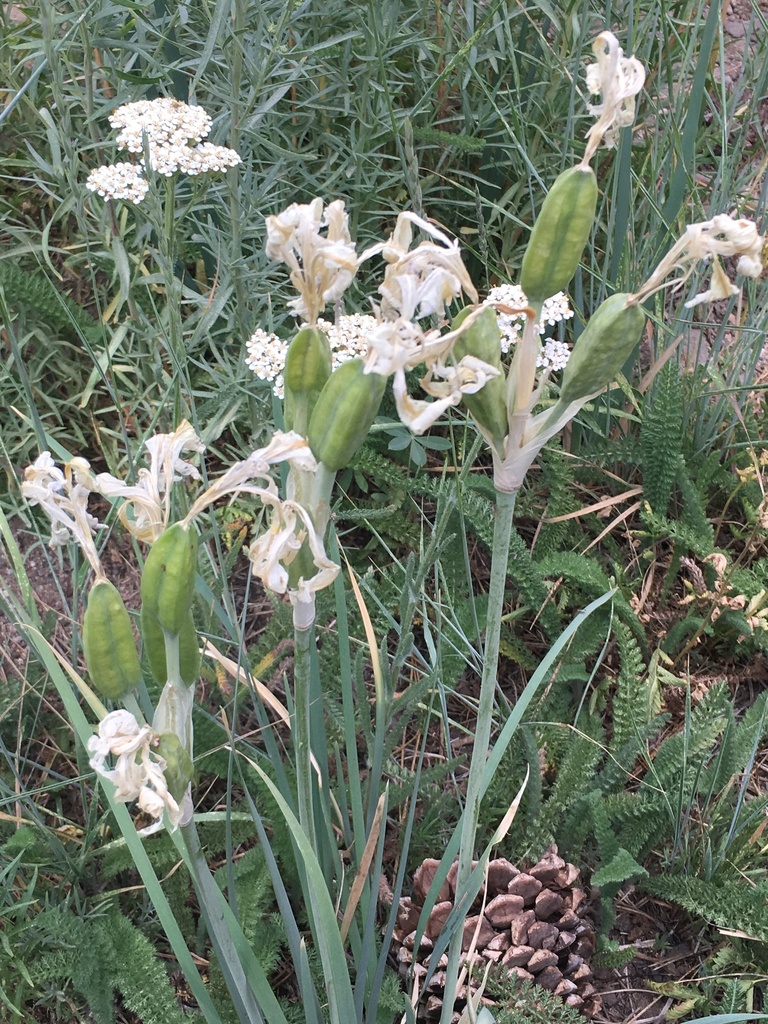
Rocky Mountain iris is rated fire resistant, with a 9.5-out-of-10 Colorado score and favorable regional recommendations.
The 9.5 score for Iris missouriensis comes from the joint landscape-plant publication of Colorado State University Extension and the Colorado State Forest Service. Their recommended scores for defensible-space Zones 1 and 2 run from eight to ten, so 9.5 meets the stated criterion.
Nevada's Tahoe guide gives the perennial a low fire-hazard estimate. Its rating is expressly a rough estimate rather than a scientific-trial result. The same guide warns about browning vegetation and advises mowing forbs and grasses when they begin turning brown.
Michigan recommends the species for its climate, and Fremont County includes it among Firewise ground covers. New Mexico provides a more detailed planting selection: no at 4,000 feet, uncertainty at 5,000, and yes at each printed elevation from 6,000 through 9,000-plus. Those are New Mexico's recommendation codes, not universal elevation needs of the iris. They add local planting context to the favorable score and listings.
Form
perennial
Mature height
~1 ft
Water need
high
Rated in
Colorado / Rocky Mountain Front Range; Fremont County, Wyoming; Lake Tahoe Basin, Nevada and California; Michigan / Great Lakes +1
On this lot
1. Fire evidence and conditions
Fire evidence
Fire-resistant — location does not change the cited classification.
Colorado State University Extension and the Colorado State Forest Service publish Fact Sheet 6.305 for Colorado's WUI and varied ecosystems. FireApproved exposes all 114 exact source owners at Colorado publication scope while retaining score, elevation, water, and Idaho-carrier lineage. Publication scope is not suitability for every Colorado site or zone.
Fremont County (WY footprint); partial normalized coverage · 2011-02-25
The source identifies itself as the Fremont County Firewise Plant List. FireApproved publishes its 92 exact source owners as Fremont County regional context. No methodology, current county endorsement, statewide Wyoming scope, or site-specific suitability is inferred.
Michigan State University Extension Bulletin E2948 is explicitly a list of wildfire-resistant landscape plants for Michigan and includes a Michigan-native field. FireApproved publishes 221 exact GBIF owners from 226 represented source rows and holds 15 complex or non-exact rows. This dated publication scope is not a current site-suitability determination.
New Mexico Forestry Division publishes this as its FireWise Plant List for New Mexico. FireApproved accounts for all 140 printed rows and publishes 95 exact same-rank owners already represented in the directory; 29 exact taxa without an existing record, 14 unresolved spellings or higher-rank matches, one compound taxon cell, and one species row whose only apparent owner has an infraspecific printed identity remain held. Every published row retains the source's Y, N, ?, or blank elevation cells. Publication scope does not erase those elevation limits or establish suitability for every New Mexico site.
Nevada Division of Forestry and University of Nevada Cooperative Extension publish Bulletin 06-01 for the Lake Tahoe Basin and vicinity. FireApproved publishes 83 exact rated owners as basin context across Nevada and California. Rough estimates are not statewide or site ratings.
2. Why this plant is relevant here
State distribution
Documented in AZ, CA, CO, ID, MN, MT, ND, NE, NM, NV, OR, SD, UT, WA, WY.
Native range
Current cited native range in AZ, CA, CO, ID, MT, NE, NM, NV, OR, SD, UT, WA, WY.
Introduced / established
USDA hardiness
2 applicable cited hardiness statements overlap but have different boundaries; compare each complete source row.
3. Legal, ecological, and broader status
Legal-list status
Seed-list status
Reported invasive here
Broader regional context
Federal context
How to read this page
The status above is computed from the cited rows below: independent recommendations can support a fire-resistant result, an avoid row can produce keep-away, and disagreement stays visible as conflict. Placement notes preserve each source’s own scheme rather than translating unlike rules into one scale. This is evidence about a plant, not permission to plant it in every part of the defensible space; Zone 0 remains noncombustible.
Native and introduced range evidence
These are exact U.S. botanical-area records from the cited range source. Native and
introduced describe biogeographic relationship, not fire performance or planting approval.
Doubtful and extinct rows stay visible but do not count as current presence.
The lossless worldwide derivative is retained once in the research corpus; object pages repeat only exact U.S. areas needed by the local lens. The JSON twin carries the same page assertions.
Plant hardiness evidence
These values describe the plant source. Your ZIP zone comes from the separate 2023 USDA
Plant Hardiness Zone Map. Whole-zone values stay whole-zone, and a single unresolved value
is not treated as a tolerance range. Different source boundaries stay separate: overlapping
statements are compared independently, while only ranges with no shared zone are called a conflict.
Source location: PlantCharacteristics record 27555, Temperature, Minimum (°F).
Where its sources say to plant it
Placement rules below use each source's own distances or named zones, tied to its rating.
They are not interchangeable with the directory's current Zone 0 guidance.
Ignition-Resistant Landscape Plants: suitable for defensible-space zones 1-2 (score 8+) [CSU defensible-space zone] (with its recommendation)
Home Landscaping Guide for Lake Tahoe and Vicinity: Fire Hazard column: low [tahoe-guide-2006] (with its recommendation)
FireWise Plant List for New Mexico: PDF page 5, Flowers and Ground Covers, p5-r29 [nm-emnrd-firewise-table-row] (with its recommendation)
The evidence
Grouped by what each source concluded. Primary evidence rated the plant itself
(a lab, field program, or original curation); corroboration compiled or
republished another source's rating and resolves to its root lineage.
“low — Blue flag iris, western — Iris missouriensis”
Table 1's Fire Hazard column prints “low” for this taxon. The guide calls the rating a rough estimate of potential flammability, not a result of scientific trials. Its footnote says plants that turn brown often become high fire hazards and tells readers to mow grasses and forbs when they begin to turn brown.
“Fremont County Firewise Plant List — Iris missouriensis — Native Iris”
Listed in the source's Ground Covers section; the page describes its listed Firewise plants as generally low-growing, low-debris, and relatively moist.
FireWise Plant List for New Mexico — New Mexico Energy, Minerals and Natural Resources Department, Forestry Division · 2003 Forestry Division PDF · original sourceCorroborationCompilationlineage: csu-nmsu-firewise
“FireWise Plant List for New Mexico”
Listed as Iris missouriensis (Wild iris) in Flowers and Ground Covers. Printed elevation cells: 4,000 ft=N, 5,000 ft=?, 6,000 ft=Y, 7,000 ft=Y, 8,000 ft=Y, 9,000+ ft=Y. Water need: M-H; sun/shade: S; mature height: 2-3’; approximate bloom: Jun.