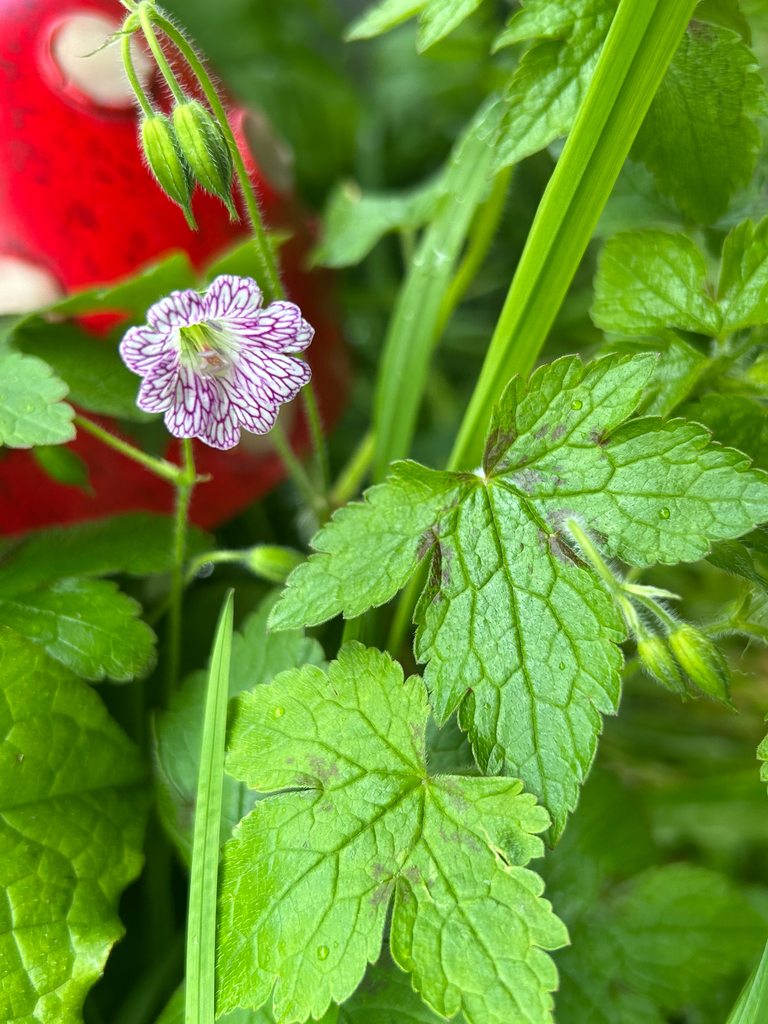
Photo: no rights reserved (CC0),
via iNaturalist. Species-typical, not necessarily this cultivar.
veiny geranium
Geranium striatum (accepted: Geranium versicolor) · Geraniaceae · all Geranium records · also called Bloody Cranesbill · syn. Geranium striatum · Wikipedia
The Place chip compares this record with your lot.
Southern Idaho (ID footprint); partial normalized coverage · 2013-11-08
The official database labels itself "For Southern Idaho" and describes Idaho residents at the urban-rangeland interface. FireApproved publishes 419 existing plant owners that cite its scored rows. This bounded Southern Idaho scope is regional context, not statewide coverage or a conclusion that the score transfers unchanged to every Idaho site.
2. Why this plant is relevant here
State distribution
Documented in ID, PA.
Native range
Introduced / established
1 sourced range or established record. This is not an invasive warning.
USDA hardiness
Documented range 4–9.
3. Legal, ecological, and broader status
Legal-list status
Seed-list status
Reported invasive here
Broader regional context
Federal context
How to read this page
The status above is computed from the cited rows below: independent recommendations can support a fire-resistant result, an avoid row can produce keep-away, and disagreement stays visible as conflict. Placement notes preserve each source’s own scheme rather than translating unlike rules into one scale. This is evidence about a plant, not permission to plant it in every part of the defensible space; Zone 0 remains noncombustible.
Plant hardiness evidence
These values describe the plant source. Your ZIP zone comes from the separate 2023 USDA
Plant Hardiness Zone Map. Whole-zone values stay whole-zone, and a single unresolved value
is not treated as a tolerance range. Different source boundaries stay separate: overlapping
statements are compared independently, while only ranges with no shared zone are called a conflict.
4–9 explicit range · whole zone precision · source stated
Source taxon: Geranium striatum · exact match.
Source location: Grayleaf cranesbill or bloody cranesbill profile, USDA hardiness zones field.
Where its sources say to plant it
Placement rules below use each source's own distances or named zones, tied to its rating.
They are not interchangeable with the directory's current Zone 0 guidance.
Fire Resistance of Plants Master Database: plantable at 30' from home [Idaho minimum planting distance] (with its recommendation)
Fire-resistant plant profile galleries: Grayleaf cranesbill or bloody cranesbill — Geranium striatum [osu-2023-perennials-gallery] (with its recommendation)
The evidence
Grouped by what each source concluded. Primary evidence rated the plant itself
(a lab, field program, or original curation); corroboration compiled or
republished another source's rating and resolves to its root lineage.
“Choose the right perennial plants for your fire-resistant landscape”
· original source
The Grayleaf cranesbill or bloody cranesbill profile prints Geranium cinereum or Geranium striatum. The gallery points to PNW 590 for complete details.