United States / Grow / Hazelnuts
Hazelnuts
Of five assessed hazelnuts, four are rated fire resistant; for the fifth, the sources do not take a side.
Common filbert, the most-studied member of Corylus, and American hazelnut each have substantial assessment behind their fire-resistant ratings. Turkish hazelnut is also rated resistant. Beaked hazelnut lands on the resistant side on a handful of assessments, although FireSmart BC has flagged it as needing more research. Its rating is favorable, but less settled than the support for common filbert or American hazelnut.
Common filbert’s rating includes a qualitative garden-suitability method that combines fire evidence with fuel structure, maintenance, and species-specific care. That makes it a broader landscape judgment rather than a simple measurement of how readily plant material ignites. The American hazelnut description identifies it as a native shrub at lower elevations, but gives no mechanism explaining its rating.
Corylus belongs to the Betulaceae family and is grown as shrubs and trees. Among four measured members, mature height runs from about 6 to 25 feet, while two zoned members span USDA zones 2a to 5a. Those details do not show which forms received which ratings. The sound conclusion is favorable but species-specific: common filbert has the deepest support, while beaked hazelnut still carries an explicit call for further study.
 Rated as a group: hazelnut Corylus sp. Awaiting evidence Mid-scale score 2 sources rate the genus as a
whole. Species evidence never rolls upward into a genus verdict, and genus claims never
override a species record.
›
Rated as a group: hazelnut Corylus sp. Awaiting evidence Mid-scale score 2 sources rate the genus as a
whole. Species evidence never rolls upward into a genus verdict, and genus claims never
override a species record.
› Fire-resistant: 4 species
-
 common filbert Fire-resistant Corylus avellana 'Contorted'
 -
 American hazelnut Fire-resistant Corylus americana
 -
 beaked hazelnut Fire-resistant Corylus cornuta
 -
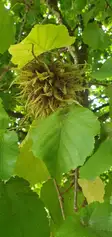 Turkish hazelnut Fire-resistant Corylus colurna
About hazelnuts
Directory notes
More about Corylus: Wikipedia — external references; not evidence sources.