United States / Grow / Bittersweets
Bittersweets
Bittersweets warrant caution: two of four assessed bittersweets are rated keep away, while sources take no side on the other two.
Oriental bittersweet, or Celastrus orbiculata, is rated keep away on a handful of assessments. Bittersweet identified more broadly as Celastrus spp. receives the same warning on a single listing. The notes accompanying both findings emphasize invasiveness. Oriental bittersweet is described as very invasive, while the broader bittersweet assessment says the exotic species is invasive.
Celastrus belongs to the Celastraceae family, and all its members are vines. Among the two members measured, mature height runs from about 15 to 50 feet; among the two members zoned, hardiness spans USDA zones 3a to 5a. Members are native in the Southeast, the Northeast, the north-central United States, and the Northwest. Those details identify the plants but do not settle their fire behavior. Ohio State University Extension rates Celastrus spp. H, one step below the top of its five-point flammability scale.
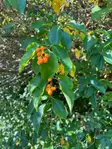 Rated as a group: bittersweet Celastrus spp. Keep away Limited evidence 1 source rate the genus as a
whole. Species evidence never rolls upward into a genus verdict, and genus claims never
override a species record.
›
Rated as a group: bittersweet Celastrus spp. Keep away Limited evidence 1 source rate the genus as a
whole. Species evidence never rolls upward into a genus verdict, and genus claims never
override a species record.
› Keep away: 1 species
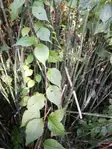
Awaiting evidence: 2 species
-
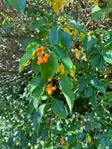 American bittersweet Awaiting evidence Celastrus scandens
 - Oriental bittersweet Awaiting evidence Celastrus paniculatus
About bittersweets
Directory notes
More about Celastrus: Wikipedia — external references; not evidence sources.
The answer for bittersweets is no. Here is what to plant instead.
Alternatives matched by form and place, each carrying its own evidence.