United States / Grow / Reedgrass
Reedgrass
No, the available assessments do not support calling reedgrasses fire resistant.
Of five Calamagrostis members assessed, three are rated keep away and none is rated resistant.
The warnings cover each member given a verdict. Reedgrass, listed as Feather Reed Grass, is rated keep away on two listings. University of Arizona Cooperative Extension in Yavapai County lists reedgrass as fire prone: plants in that category may ignite readily and burn intensely. Its fire-resistant category describes plants that tend to resist ignition with irrigation and maintenance. Calamagrostis x acutifolia is rated keep away on a single listing; its assessment also notes that it remains upright through winter.
European beachgrass is likewise rated keep away on a single listing. Its assessment gives it a high-flammability classification and says it appears on FENZ’s high-flammability environmental weeds list, with a parenthetical reference to the 2024 DOC list. The other two Calamagrostis members were assessed without the sources taking a side. Their silence does not amount to a resistant rating.
Calamagrostis belongs to the grass family, with members native to subarctic North America and the southwestern, northwestern and northeastern United States. Across the genus’s own assessments, every stated verdict points away from treating reedgrass as a fire-resistant choice.
 Rated as a group: reedgrass Calamagrostis spp. Keep away Limited evidence 2 sources rate the genus as a
whole. Species evidence never rolls upward into a genus verdict, and genus claims never
override a species record.
›
Rated as a group: reedgrass Calamagrostis spp. Keep away Limited evidence 2 sources rate the genus as a
whole. Species evidence never rolls upward into a genus verdict, and genus claims never
override a species record.
› Keep away: 2 species
-
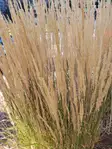 Calamagrostis x acutifolia Keep away Calamagrostis x acutifolia
 -
 European beachgrass Keep away Calamagrostis arenaria
Awaiting evidence: 2 species
- bluejoint Awaiting evidence Calamagrostis canadensis
- Wood Small-Reed Awaiting evidence Calamagrostis epigejos
About reedgrass
Directory notes
More about Calamagrostis: Wikipedia — external references; not evidence sources.
The answer for reedgrass is no. Here is what to plant instead.
Alternatives matched by form and place, each carrying its own evidence.