Enter your ZIP to see whether this is legal to plant in your state, and whether it survives your winter.
Loquat earns two fire-resistant listings, but moderate ratings elsewhere make the overall answer mixed rather than a clear yes.
Two services give loquat favorable fire ratings. Fire Safe Marin lists it as fire-resistant in Marin County, while stressing placement, spacing, irrigation, and removal of dead material. The Australian Capital Territory government’s plant selector marks Eriobotrya japonica as fire retardant.
Other assessments are more cautious. The USDA Forest Service and state Firewise programs rated loquat “Moderately Firewise,” the second band of their four-part scale. The Tasmania Fire Service assigns it moderate flammability, which means avoiding it inside that service’s Building Protection Zone. These regional systems use different categories and premises, so their judgments do not collapse into one universal label.
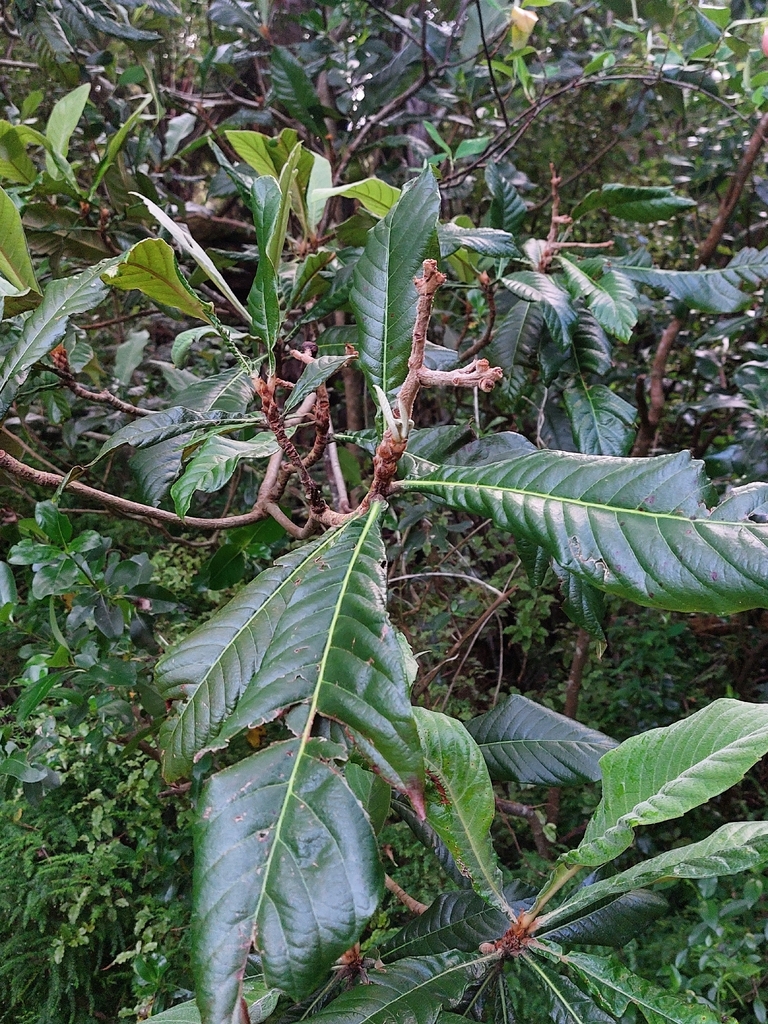
A laboratory measurement adds context without settling the disagreement. Predried loquat branches tested with a grill device reached a maximum flame temperature of 691.4°C. That figure describes flame temperature under those experimental conditions, while the FLAMITS database sets no threshold that converts it into a resistant or hazardous verdict. Loquat is a tree in the rose family that reaches about 15 feet at maturity and is hardy to USDA zone 8a. Its favorable listings support considering it, but the moderate ratings make local fire guidance and plant maintenance decisive.
Form
tree
Mature height
~15 ft
Light
Full sun
Rated in
Australian Capital Territory, Australia; Global; Marin County, California; Tasmania, Australia +1
On this lot
1. Fire evidence and conditions
Fire evidence
Mixed evidence — location does not change the cited classification.
Marin County (CA footprint); partial normalized coverage · 2019-01-01
The publication is explicitly limited to plants common to Marin County. FireApproved publishes 104 exact owners as Marin regional context while retaining its placement, spacing, irrigation, and maintenance boundary. It is not statewide California guidance or parcel suitability.
2. Why this plant is relevant here
State distribution
Documented in CA, DC, DE, FL, GA, HI, LA, MD, NJ, OH, PA, PR, WV.
Native range
Introduced / established
USDA hardiness
Only uncertain or inapplicable hardiness rows are cited; no primary zone is projected.
3. Legal, ecological, and broader status
Legal-list status
Seed-list status
Reported invasive here
2 ecological invasive reports.
Broader regional context
Federal context
How to read this page
The status above is computed from the cited rows below: independent recommendations can support a fire-resistant result, an avoid row can produce keep-away, and disagreement stays visible as conflict. Placement notes preserve each source’s own scheme rather than translating unlike rules into one scale. This is evidence about a plant, not permission to plant it in every part of the defensible space; Zone 0 remains noncombustible.
Plant hardiness evidence
These values describe the plant source. Your ZIP zone comes from the separate 2023 USDA
Plant Hardiness Zone Map. Whole-zone values stay whole-zone, and a single unresolved value
is not treated as a tolerance range. Different source boundaries stay separate: overlapping
statements are compared independently, while only ranges with no shared zone are called a conflict.
Source prints 8 · single-value meaning unresolved · whole zone precision · source stated
Source taxon: Eriobotrya japonica · exact match.
Source location: Cold Hardiness Zone field in the recovered selector record.
Not used for comparison: The recovered selector prints one Cold Hardiness Zone value but does not define it as a minimum threshold or a one-zone range.
Conditions in the fire evidence
These describe tested or rated plant material. They are not horticultural maintenance instructions.
Placement rules below use each source's own distances or named zones, tied to its rating.
They are not interchangeable with the directory's current Zone 0 guidance.
Eastern United States Fire Performance Plant Selector: Landscape Zone 3 — 10–30 ft from the structure; thin vegetation, remove debris, and minimize plant massing [Fire Performance Plant Selector landscape zone] (mid-scale rating)
Fire Resisting Garden Plants for the Urban Fringe and Rur…: should be avoided in the Building Protection Zone [Texas Building Protection Zone] (mid-scale rating)
Canberra Plant Selector: filtered result page 11 [canberra-selector] (with its recommendation)
The evidence
Grouped by what each source concluded. Primary evidence rated the plant itself
(a lab, field program, or original curation); corroboration compiled or
republished another source's rating and resolves to its root lineage.
5 cited rows from this source; its identity, lineage and tier are stated once.
Primary study Pacheco2022: Pacheco, A. S., Goodman, H. D., Hankenson, L., Fisk, J. J., Ortiz, A., Marinace, H. M., ... Tng, D. Y. P. (2022). Fighting fire with food: Assessing the flammability of crop plant species for building fire resilient agroforestry systems. in review, preprint.
Shared row context: plant part branches; fuel all; predrying yes; device grill; site Pacheco2022-1; sampling october to november 2022.
“maximum flame temperature (°C): 691.4”
FLAMITS record 16405; Combustibility measurement.
“burning duration (s): 11.33333333”
FLAMITS record 16406; Sustainability measurement.
“estimated burnt biomass (%): 4”
FLAMITS record 16407; Consumability measurement.
Primary study Tian2003: Tian, X., Shu, L., & Zhang, X. (2003). Study on the influence of microstructure of trees twig and leaf on combustibility. Scientia Silvae Sinicae, 39, 8488.
Shared row context: plant part leaves; fuel live; predrying yes; device calorimeter; site Tian2003-1; sampling ND.