United States / Grow / scouringrush horsetail

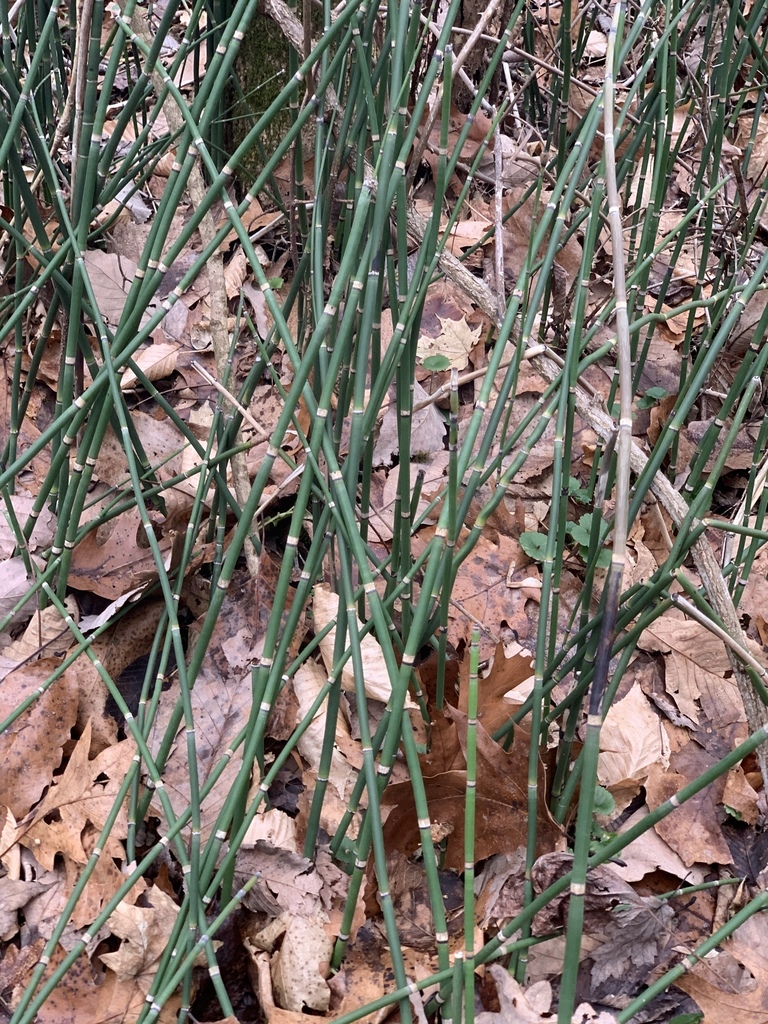
scouringrush horsetail (Equisetum hyemale)
Photo: (c) Sara Patton, some rights reserved (CC BY) (CC BY), via iNaturalist. Species-typical, not necessarily this cultivar.

scouringrush horsetail

Equisetum hyemale · Equisetaceae · also called Horsetail · Wikipedia

View Saved

Is this one for your yard?

Enter your ZIP to see whether this is legal to plant in your state, and whether it survives your winter.

Scouringrush horsetail has mixed fire guidance in the Eastern US selector: At Risk, a No for ladder potential without pruning, and LZ2.

The historical Fire Performance Plant Selector lists Equisetum hyemale as a wetland plant; its curated grade is not an ignition-test result. A damp planting site therefore does not establish favorable fire performance.

For a wet garden, the useful distinction is between site suitability and the source's warning. Its row describes partial sun, adaptable soil pH, high tolerance of poor drainage and medium drought resistance. It marks both native and invasive as Yes, with the specific warning that horsetail can be very invasive in warmer regions. That regional observation matters when weighing its floral-arrangement use; native status alone does not settle its suitability.

The selector places it in Landscape Zone 2, defined as 5 to 10 feet from a house in the program's high-fire-risk framework. This zone calls for a maintained lawn and fuel breaks such as paving or rock gardens, while advising against evergreens that ignite readily and burn quickly. For trees within it, mature-height clearance must be at least 10 feet vertically and horizontally from the structure, with 10 to 15 feet between crown edges. Those are tree requirements, not horsetail planting intervals.

The row's No for ladder potential without pruning does not cancel routine upkeep. Remove dead leaves, needles and twigs; prune dead, diseased and low branches in the surrounding planting; preserve horizontal and vertical separation; and water and prune to prevent deadwood buildup. Wetland tolerance, spread and fire grade remain separate selection questions.

Form
perennial
Mature height
~3 ft
Light
Part sun
Rated in
eastern US
On this lot

1. Fire evidence and conditions

Fire evidence
Mixed evidence — location does not change the cited classification.
Placement evidence
1 source placement record; source schemes remain separate.
Evidence regions
eastern US

2. Why this plant is relevant here

State distribution
Documented in AK, AL, AR, AZ, CA, CO, CT, DC, DE, FL, GA, IA, ID, IL, IN, KS, KY, LA, MA, MD, ME, MI, MN, MO, MS, MT, NC, ND, NE, NH, NJ, NM, NV, NY, OH, OK, OR, PA, RI, SC, SD, TN, TX, UT, VA, VT, WA, WI, WV, WY.
USDA hardiness
Only uncertain or inapplicable hardiness rows are cited; no primary zone is projected.

3. Legal, ecological, and broader status

How to read this page

The status above is computed from the cited rows below: independent recommendations can support a fire-resistant result, an avoid row can produce keep-away, and disagreement stays visible as conflict. Placement notes preserve each source’s own scheme rather than translating unlike rules into one scale. This is evidence about a plant, not permission to plant it in every part of the defensible space; Zone 0 remains noncombustible.

Plant hardiness evidence

These values describe the plant source. Your ZIP zone comes from the separate 2023 USDA Plant Hardiness Zone Map. Whole-zone values stay whole-zone, and a single unresolved value is not treated as a tolerance range. Different source boundaries stay separate: overlapping statements are compared independently, while only ranges with no shared zone are called a conflict.

Where its sources say to plant it

Placement rules below use each source's own distances or named zones, tied to its rating. They are not interchangeable with the directory's current Zone 0 guidance.

The evidence

Grouped by what each source concluded. Primary evidence rated the plant itself (a lab, field program, or original curation); corroboration compiled or republished another source's rating and resolves to its root lineage.

Mid-scale / conditional (1)

Fire-resistant perennials instead

Last verified 2026-08-23. JSON (CC BY 4.0)

Profiles: USDA PLANTS · GBIF · iNaturalist · Wikidata · Wikipedia · ITIS

Equisetum hyemale (Horsetail). FireApproved. https://fireapproved.com/plants/equisetum-hyemale/. Last verified 2026-08-23.