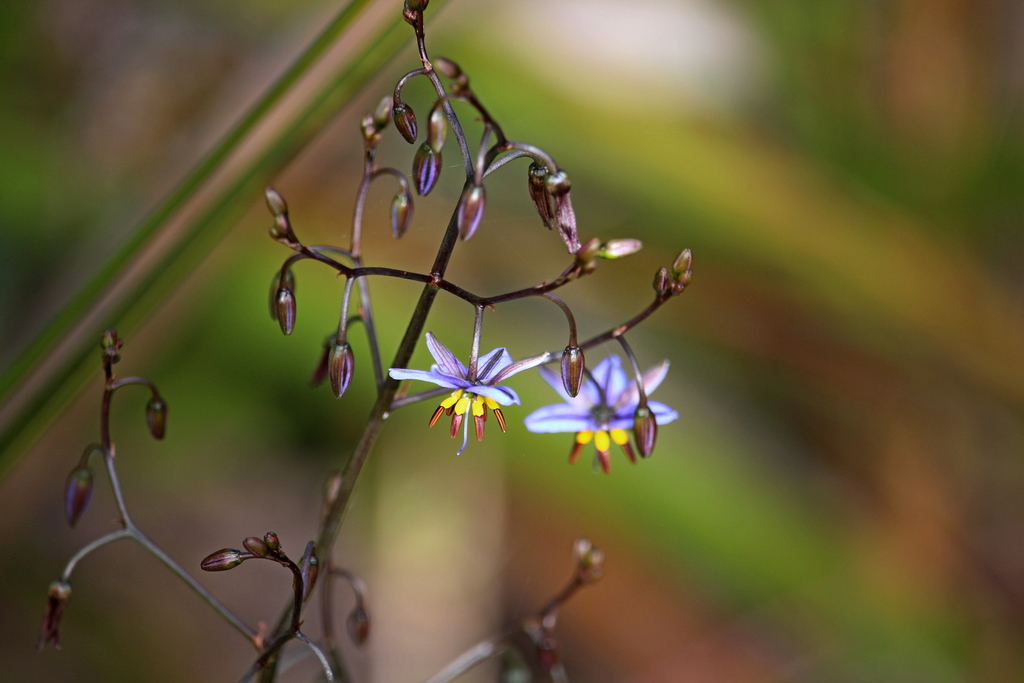
Enter your ZIP to see whether this is legal to plant in your state, and whether it survives your winter.
Yes, blue berry flax-lily is rated fire resistant, though that does not mean it cannot burn.
All four sources support that conclusion, but they describe it in different ways. Australian Plants Society Victoria’s field trials place Dianella tasmanica in the fire-retardant class: it resists the first flame wave but may burn once dried out. The ACT Government’s plant selector also marks the species “Fire Retardant: Yes.” These findings support its use without claiming that it will remain unburned during prolonged exposure.
The other assessments point in the same direction. The Sun City Texas Firewise Group rates flax lily low for flammability hazard, which it defines as the ease with which a plant burns at high temperatures for a prolonged period. Ozbreed placed five Dianella tasmanica cultivars, including Blaze, Tasred, Wyeena, Destiny and Emerald Arch, on its second list because the genus and species appear regularly on multiple fire-retardant plant lists.
Blue berry flax-lily is a shrub in the Asphodelaceae family. The consistent ratings make it a reasonable lower-flammability choice, but the field-trial wording supplies the necessary limit: once the plant has dried, it may still burn. “Fire resistant” therefore means better able to resist initial flame exposure, not fireproof.
Form
shrub
Region
Victoria, Australia
Rated in
Australia; Australian Capital Territory, Australia; Georgetown, Texas; Victoria, Australia
On this lot
1. Fire evidence and conditions
Fire evidence
Fire-resistant — location does not change the cited classification.
Sun City Texas, Georgetown (TX footprint); partial normalized coverage · 2015-01-14
The guide is authored for the Sun City Texas community in Georgetown. FireApproved publishes 142 exact owners only as community-level context. It is an archived HOA exhibit with unknown rating lineage, not a current statewide Texas source or an independent Tier 1 determination.
2. Why this plant is relevant here
State distribution
Native range
Introduced / established
USDA hardiness
3. Legal, ecological, and broader status
Legal-list status
Seed-list status
Reported invasive here
Broader regional context
Federal context
How to read this page
The status above is computed from the cited rows below: independent recommendations can support a fire-resistant result, an avoid row can produce keep-away, and disagreement stays visible as conflict. Placement notes preserve each source’s own scheme rather than translating unlike rules into one scale. This is evidence about a plant, not permission to plant it in every part of the defensible space; Zone 0 remains noncombustible.
Where its sources say to plant it
Placement rules below use each source's own distances or named zones, tied to its rating.
They are not interchangeable with the directory's current Zone 0 guidance.
Firewise Plant Guide: Shrubs [Sun City plant-table sections] (with its recommendation)
Canberra Plant Selector: filtered result page 20 [canberra-selector] (with its recommendation)
The evidence
Grouped by what each source concluded. Primary evidence rated the plant itself
(a lab, field program, or original curation); corroboration compiled or
republished another source's rating and resolves to its root lineage.
The table rates Flax Lily — Dianella tasmanica low for flammability hazard, defined as the ease a plant can burn at high temperatures for a prolonged time.