Enter your ZIP to see whether this is legal to plant in your state, and whether it survives your winter.
Giant reed is not fire resistant; two expert plant guides place it in their highest fire-risk categories.
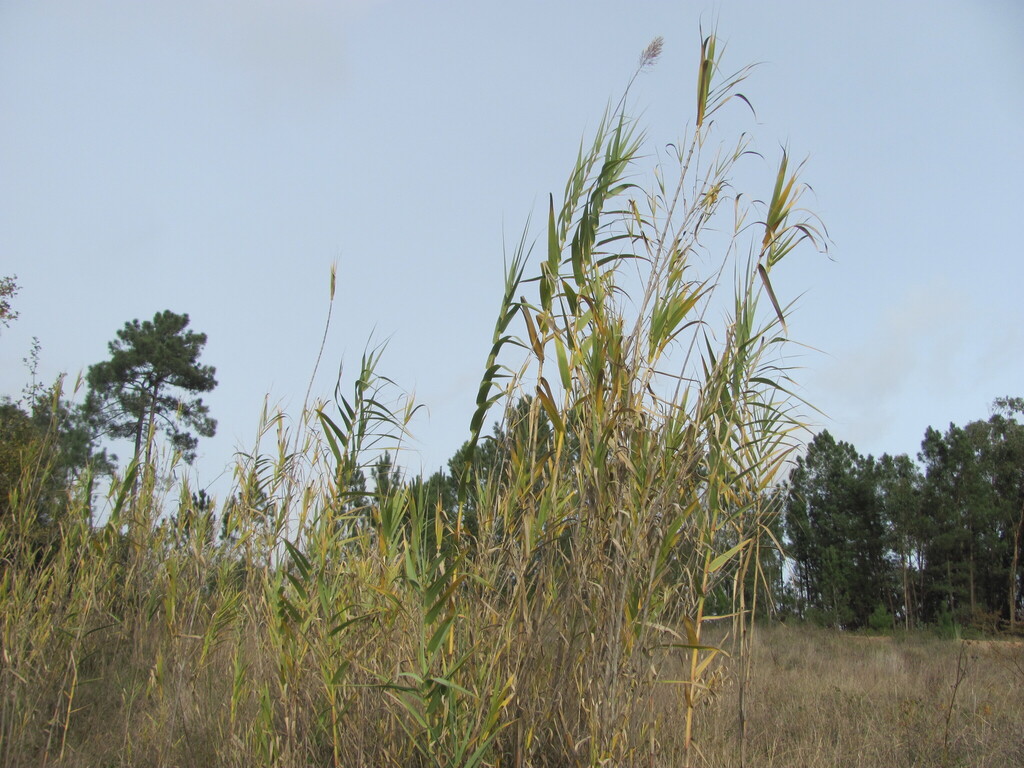
The USDA Forest Service and state Firewise programs rate giant reed in the worst category on their four-point scale. They describe it as a bamboo-like grass that tolerates heat. Ohio State University Extension independently assigns it “VH,” or very high flammability, on a five-band scale. This agreement supports treating the plant as highly flammable and keeping it away from structures.
Heat tolerance and high water needs should not be mistaken for fire resistance. Giant reed grows in full sun and reaches about 15 feet at maturity, so the warning applies to a substantial grass rather than a small ornamental. It has also been introduced in 25 states and flagged as invasive in two jurisdictions. Where it is already growing near a home, the fire ratings give no basis for considering it a protective or low-risk planting.
Ohio State University Extension Bulletin 921 is an Ohio publication that describes Ohio fire seasons and landscape conditions and labels nativity to Ohio. FireApproved publishes 352 exact source-owning plant records from its eight rated tables. This historical publication scope does not assert current extension endorsement or that a listed plant suits every Ohio site.
2. Why this plant is relevant here
State distribution
Documented in AL, AR, AZ, CA, DC, DE, FL, GA, HI, IL, KS, KY, LA, MD, MO, MS, NC, NJ, NM, NV, OH, OK, PA, PR, SC, TN, TX, UT, VA, VI, WV.
Native range
Introduced / established
26 sourced range or established records. This is not an invasive warning.
USDA hardiness
Documented minimum 7b; no upper limit is documented.
3. Legal, ecological, and broader status
Legal-list status
3 legal-list records; the Place chip matches exact scope.
Seed-list status
4 state noxious-weed seed records; the Place chip matches exact scope.
Reported invasive here
2 ecological invasive reports.
Broader regional context
Federal context
Plant-specific legal-list reviews (1)
These source-bound review receipts are separate from ecological invasive reports. A source or plant identity change invalidates a receipt.
NV · Noxious-listed here. Designated noxious listed in the reviewed Nevada NAC 555.010 Category A, B, and C Noxious Weeds as of 2026-08-26. Authority: Nevada State Quarantine Officer; scope: state; as of 2026-08-26.Official reference.Normalized source record.
How to read this page
The status above is computed from the cited rows below: independent recommendations can support a fire-resistant result, an avoid row can produce keep-away, and disagreement stays visible as conflict. Placement notes preserve each source’s own scheme rather than translating unlike rules into one scale. This is evidence about a plant, not permission to plant it in every part of the defensible space; Zone 0 remains noncombustible.
Native and introduced range evidence
These are exact U.S. botanical-area records from the cited range source. Native and
introduced describe biogeographic relationship, not fire performance or planting approval.
Doubtful and extinct rows stay visible but do not count as current presence.
The lossless worldwide derivative is retained once in the research corpus; object pages repeat only exact U.S. areas needed by the local lens. The JSON twin carries the same page assertions.
Plant hardiness evidence
These values describe the plant source. Your ZIP zone comes from the separate 2023 USDA
Plant Hardiness Zone Map. Whole-zone values stay whole-zone, and a single unresolved value
is not treated as a tolerance range. Different source boundaries stay separate: overlapping
statements are compared independently, while only ranges with no shared zone are called a conflict.
Source prints 6 · single-value meaning unresolved · whole zone precision · source stated
Source taxon: Arundo donax · exact match.
Source location: Cold Hardiness Zone field in the recovered selector record.
Not used for comparison: The recovered selector prints one Cold Hardiness Zone value but does not define it as a minimum threshold or a one-zone range.
Source location: PlantCharacteristics record 20580, Temperature, Minimum (°F).
Fire ecology context
The Forest Service's Fire Effects Information System synthesizes how this exact taxon responds
to wildland fire and occurs in fire-shaped ecosystems. This literature context does not rate a
maintained landscape plant, does not change the computed classification above, and is not a
substitute for building-adjacent placement guidance.
USDA Forest Service FEIS · review ARUDON
Arundo donax, giant reed
Immediate fire effect. The 2004 review reports only anecdotal evidence that fire top-kills shoots while underground rhizomes usually survive. (Immediate Fire Effects)
Postfire response. Observations available to the review describe rapid rhizome sprouting after fire, but no postfire-response research was available in 2004. (Plant Response to Fire)
Invasive–fire feedback. Southern California accounts suggest dense, dry biomass can turn invaded riparian corridors into fire pathways, but FEIS labels the evidence anecdotal and limited. (Fire Regimes)
Management considerations. Prescribed burning alone is unlikely to control giant reed because it does not kill the rhizomes and may favor regeneration over native riparian plants. (Fire as a Control Agent)
Source taxon: Arundo donax · exact scientific name ·
review written 2004-05 · page updated 2025-12-09 ·
source record
Where its sources say to plant it
Placement rules below use each source's own distances or named zones, tied to its rating.
They are not interchangeable with the directory's current Zone 0 guidance.
Eastern United States Fire Performance Plant Selector: Landscape Zone 4 — beyond 30 ft; outside the selector's recommendation area [Fire Performance Plant Selector landscape zone] (with its avoid rating)
Firewise Landscaping: plant in Zone 2-3 or beyond [OSU B921 source-category siting] (with its avoid rating)
The evidence
Grouped by what each source concluded. Primary evidence rated the plant itself
(a lab, field program, or original curation); corroboration compiled or
republished another source's rating and resolves to its root lineage.