Southern Idaho (ID footprint); partial normalized coverage · 2013-11-08
The official database labels itself "For Southern Idaho" and describes Idaho residents at the urban-rangeland interface. FireApproved publishes 419 existing plant owners that cite its scored rows. This bounded Southern Idaho scope is regional context, not statewide coverage or a conclusion that the score transfers unchanged to every Idaho site.
Maryland Forest Service says the list contains plants that can be grown in Maryland and identifies Maryland natives. FireApproved publishes 169 exact source owners from the 180 printed rows; an unrepresentable form and duplicate-owner rows are not broadened. The list calls itself non-comprehensive and does not establish suitability for every Maryland site.
NJ; partial normalized coverage
New Jersey DEP publishes a state edition saying the listed plants can be grown in New Jersey and are relatively resistant to fire. Its same 180 printed taxon occurrences map to the 169 conservative owners already normalized for the template family. The list is non-comprehensive and does not establish suitability for every New Jersey site or override the Pinelands Commission's separate placement and fuel-break rules.
WV; partial normalized coverage · 2026-08-26
West Virginia Division of Forestry publishes a state edition saying the listed plants can be grown in West Virginia and are relatively resistant to fire. Its same 180 printed taxon occurrences map to the 169 conservative owners already normalized for the template family. The list is non-comprehensive and provides no comparative or site-specific rating.
2. Why this plant is relevant here
State distribution
Native range
Introduced / established
USDA hardiness
3. Legal, ecological, and broader status
Legal-list status
Seed-list status
Reported invasive here
Broader regional context
Federal context
How to read this page
The status above is computed from the cited rows below: independent recommendations can support a fire-resistant result, an avoid row can produce keep-away, and disagreement stays visible as conflict. Placement notes preserve each source’s own scheme rather than translating unlike rules into one scale. This is evidence about a plant, not permission to plant it in every part of the defensible space; Zone 0 remains noncombustible.
Where its sources say to plant it
Placement rules below use each source's own distances or named zones, tied to its rating.
They are not interchangeable with the directory's current Zone 0 guidance.
Fire Resistance of Plants Master Database: 40 ft minimum planting distance on flat terrain [Idaho minimum planting distance] (mid-scale rating)
Firewise Landscaping Plants: Herbaceous Annuals and Perennials [Maryland Firewise plant-form tables] (with its recommendation)
The evidence
Grouped by what each source concluded. Primary evidence rated the plant itself
(a lab, field program, or original curation); corroboration compiled or
republished another source's rating and resolves to its root lineage.
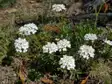
Listed as Anemone spp. (Anemone Hybrids). The source says listed species exhibit stronger resistance to ignition by wildfires. Source comments: Plants are poisonous – do not eat. Prefers partial sun and moist soils.