Home / Guides / How to read a record / The resin question at a Minnesota lake cabin
The resin question at a Minnesota lake cabin
The sap is the planting decision. Dovetail Partners (2017): trees with evergreen needles are more flammable than broadleaved deciduous trees because most needle-leaved evergreens have leaves with lower moisture content, especially during drought, and sap containing flammable resins. In northeastern Minnesota the two most flammable tree species are balsam fir and black spruce. This site currently has no Picea mariana species record. Abies balsamea currently computes as avoid and includes MN. Minnesota DNR (2004): plant nothing within 3 to 5 feet of the structure, particularly if it is sided with wood, logs, or other flammable materials.
You are at an Ely cabin putting balsam against the logs for privacy because the tree already grows in the yard. Dovetail is telling you that tree is the ladder. The 2004 sheet is telling you the first three to five feet of a log wall is not a planting bed.
This is not a Minnesota doorway.
Why it matters
“Native conifer” is easy to hear as “safe at a cabin.” Dovetail’s opened guide is resin and moisture, then pull the fir. What do you plant when the forest is the fuel is Alaska black spruce with a species page. This page is a missing P. mariana record plus balsam avoid on a Minnesota lake lot. Zone 0 is still not a planting list.
This site’s Minnesota plant evidence combines 406 occurrence records with 38 exact Dovetail owners bounded to northeastern Minnesota. That is regional fire evidence, not a statewide balsam screen.
How it works
The resin (Dovetail, 2017):
- Needle evergreens vs broadleaf: lower moisture, especially in drought, and flammable resins in the sap.
- Two most flammable trees in northeastern Minnesota: balsam fir and black spruce.
- Also quite flammable: jack pine and white spruce. Somewhat less: white pine, red pine, white cedar.
- Balsam fir is typically considered the most hazardous wildfire fuel tree in northeastern Minnesota.
- Shade-tolerant fir and spruce fill in as dog-hair understories after decades of suppression.
- Jack pine requires fire to fully open cones. That is a forest fact, not a five-foot planting.
The fires Dovetail printed:
- About 200 ignitions a year in northeastern Minnesota (Dovetail citing MN DNR wildfire GIS, 2016).
- Ham Lake 2006, about 76,000 acres.
- Pagami Creek 2011, about 93,000 acres.
- Thin or sandy soils that dry in drought.
The cabin (Minnesota DNR):
- 2004: plant nothing 3 to 5 feet, especially on wood or log siding. Decorative rock as nonflammable ground cover.
- 2004 exception: if siding is noncombustible, widely spaced low shrubs or other “fire resistant” plants are acceptable. Do not plant under windows or next to foundation vents. That exception is not Dovetail’s “plant nothing” sentence, and it is not IBHS Zone 0.
- 2004: ideally remove all conifer trees from the 30-foot Intensive Zone. Keep a few favorites only if crowns are 10 feet apart and pruned at least 8 feet.
- 2004: heavier fuels — brush and coniferous trees — produce a more intense fire than grassy fuels.
- 2024 handbook: DNR averages over 1,000 wildfires a year; over 90% people-caused; 2021, over 2,000. If the house is surrounded by evergreens, firefighters may bypass. Defensible space up to 100 feet around a home or cabin.
Two tables, two authors:
- Dovetail Table 2 is Dovetail’s own work: UF/IFAS Circular 1453 key on 38 non-invasive plants. Low = 3 to 30 feet. Moderate = beyond 30 feet. These are mostly perennials and groundcovers, not spruce.
- Dovetail Table 1 is Manitoba FireSmart, reprinted. Aspen Very Low. Birch Low. Black spruce Very High. Balsam fir Very High. White spruce High. Jack pine High. Tamarack Low. Do not store Table 1 as if Dovetail scored those trees.
The Wisconsin guide Minnesota hosts:
- PUB-FR-417-2008 (September 2008), on
files.dnr.state.mn.us. First 3-to-5 feet free of any fuel. Within 30 feet, not more than a few scattered evergreens. Deciduous trees typically burn with much less intensity than evergreens. Plant deciduous trees, not evergreens, if you plant close.
This directory:
- Minnesota: 407 records. 260 on-list, 33 avoid, 3 conflict, 111 candidate.
- No Picea mariana. No Pinus banksiana.
- Abies balsamea avoid, limited-evidence, MN.
- Picea glauca conflict, MN.
- Pinus strobus avoid, MN.
- Pinus resinosa avoid, MN.
- Populus tremuloides on-list, consensus, MN.
- Betula papyrifera on-list, limited-evidence, MN. Stored FPS claim: peeling papery bark and multi-trunk trees add fire potential. That caveat stays on the row.
- Asclepias tuberosa on-list, consensus, MN, with a stored Dovetail Low row (plantable 3–30 feet).
- Diervilla lonicera on-list, limited-evidence, MN, with a stored Dovetail Low row.
- Larix laricina candidate, MN. Manitoba’s table says tamarack Low. Candidate is not on-list.
The paths
| Claim | Opened source | What it is not |
|---|---|---|
| Resin makes the evergreen the fuel | Dovetail: lower moisture + flammable resins | A reason to plant balsam as native screening |
| Balsam and black spruce are the worst trees | Dovetail body text, NE Minnesota | A P. mariana species page on this site |
| Plant nothing in 3–5 feet | DNR 2004; Dovetail; Wisconsin 2008 | A butterfly-weed exemption for Zone 0 |
| Low-flammability Table 2 | Dovetail’s own UF/IFAS ratings, 3–30 feet | Manitoba’s tree table |
| Aspen Very Low / birch Low | Manitoba FireSmart via Dovetail Table 1 | A permit to plant against the logs |
| 406 Minnesota records | USDA distribution | A Firewise palette |
| Balsam avoid, white spruce conflict | Computed evidence | Black spruce |
| Surrounded by evergreens | 2024 handbook: firefighters may bypass | A privacy hedge argument |
What people mix up
- A native balsam with a fire-resistant cabin tree.
- Dovetail’s Table 2 (perennials they scored) with Table 1 (Manitoba’s boreal trees).
- White spruce on this site with black spruce. One has a page (conflict). The other does not.
- Jack pine’s serotinous cones with a yard pine. This site has no Pinus banksiana page. See Kirtland’s warbler country.
- Alaska black spruce (FEIS + Firewise Alaska) with Minnesota black spruce (named by Dovetail, no YAML here).
- The 2004 noncombustible-siding exception with Dovetail’s plant nothing and with IBHS 0–5-foot noncombustible.
- On-list aspen or birch with a five-foot planting.
- 1894’s 413 dead, or Ham Lake and Pagami Creek, with “Minnesota doesn’t burn.”
- A 30-foot Intensive Zone with the first five feet.
How to check
- Open Dovetail 2017. Read the resin sentence. Read “balsam fir and black spruce.” Read the Table 1 footnote: Manitoba FireSmart.
- Search this site for Picea mariana. There is no species page.
- Open Abies balsamea and Picea glauca.
- Open Creating a Firewise Property (2004) and the 2024 handbook. Read 3 to 5 feet, “ideally remove all conifer trees,” and “surrounded by evergreens.”
- Open Minnesota plant evidence. Distribution is not a recommendation.
- Do not plant in Zone 0.
Limits
This page quotes the opened Dovetail 2017 PDF, the opened 2004 Minnesota DNR property sheet, the opened 2024 Minnesota Firewise Handbook, and the opened 2008 Wisconsin guide hosted by Minnesota DNR. Live dnr.state.mn.us HTML (Firewise index, landscaper, defensible-space pages) returned HTTP 403 to curl this session and is not quoted. Ham Lake and Pagami Creek acreage and the “200 ignitions a year” line are printed as Dovetail printed them, with Dovetail’s footnotes; this page does not independently recount those fires. Table 1 values are Manitoba FireSmart as reprinted by Dovetail, not Dovetail’s UF/IFAS scores. The 406 occurrence rows and 38 Dovetail owners are directory counts, not DNR statistics. There is no Picea mariana record and no Pinus banksiana record; this page does not invent them. The 2004 sheet compiles Colorado, Wyoming, and Wisconsin publications; it is not a Minnesota-original species list. Zone 0 is not a planting list.
Related records
- Abies balsamea
- Picea glauca
- Asclepias tuberosa
- Minnesota plant evidence
- What do you plant when the forest is the fuel
- What Kirtland’s warbler country teaches
- Glossary: Zone 0
Plant records this page rests on
-
 balsam fir Abies balsamea Keep away
 -
 white spruce Picea glauca Keep away
 -
 paper birch Betula papyrifera Fire-resistant
 -
 quaking aspen Populus tremuloides Fire-resistant
 -
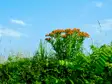 butterfly milkweed Asclepias tuberosa Fire-resistant
 -
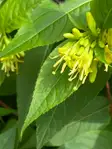 northern bush honeysuckle Diervilla lonicera Fire-resistant
 -
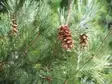 eastern white pine Pinus strobus Keep away
 -
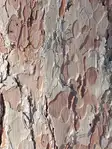 red pine Pinus resinosa Keep away
Questions
What is the resin question at a Minnesota lake cabin?
Whether the tree you planted for privacy is the fuel the DNR is asking you to pull. Dovetail Partners (2017), the only rated Minnesota plant list on this site: trees with evergreen needles are more flammable than broadleaved deciduous trees because most needle-leaved evergreens have leaves with lower moisture content, especially during drought, and sap containing flammable resins. In northeastern Minnesota the two most flammable tree species are balsam fir and black spruce. Jack pine and white spruce are also quite flammable. Minnesota DNR (2004): plant nothing within 3 to 5 feet of the structure, particularly if the building is sided with wood, logs, or other flammable materials. Ideally, remove all conifer trees from the 30-foot Intensive Zone.
Does this site have a black spruce page?
No. There is currently no Picea mariana species record. Do not invent one. The genus page for Picea is not black spruce. Picea glauca currently computes as conflict and includes MN. Abies balsamea currently computes as avoid and includes MN. Those are not P. mariana.
If aspen and birch rate low, can I plant them against the logs?
No. Dovetail reprints a Manitoba FireSmart table that rates aspen Very Low and birch Low. That table is not Dovetail’s own ratings, and it is not a five-foot planting list. Dovetail’s own Table 2 puts low-flammability plants between 3 and 30 feet, and says plant nothing in the first 3 to 5 feet. Populus tremuloides currently computes as on-list and includes MN. Betula papyrifera currently computes as on-list, limited-evidence, and includes MN. Zone 0 is still not a planting list.
Is this a Minnesota doorway page?
No. The object is resinous conifers at a lake cabin versus Dovetail’s rated perennials and the missing P. mariana record. Place claims sit on whereThisDiffers. The Minnesota plant surface keeps 406 occurrence records distinct from 38 northeastern Minnesota source owners.