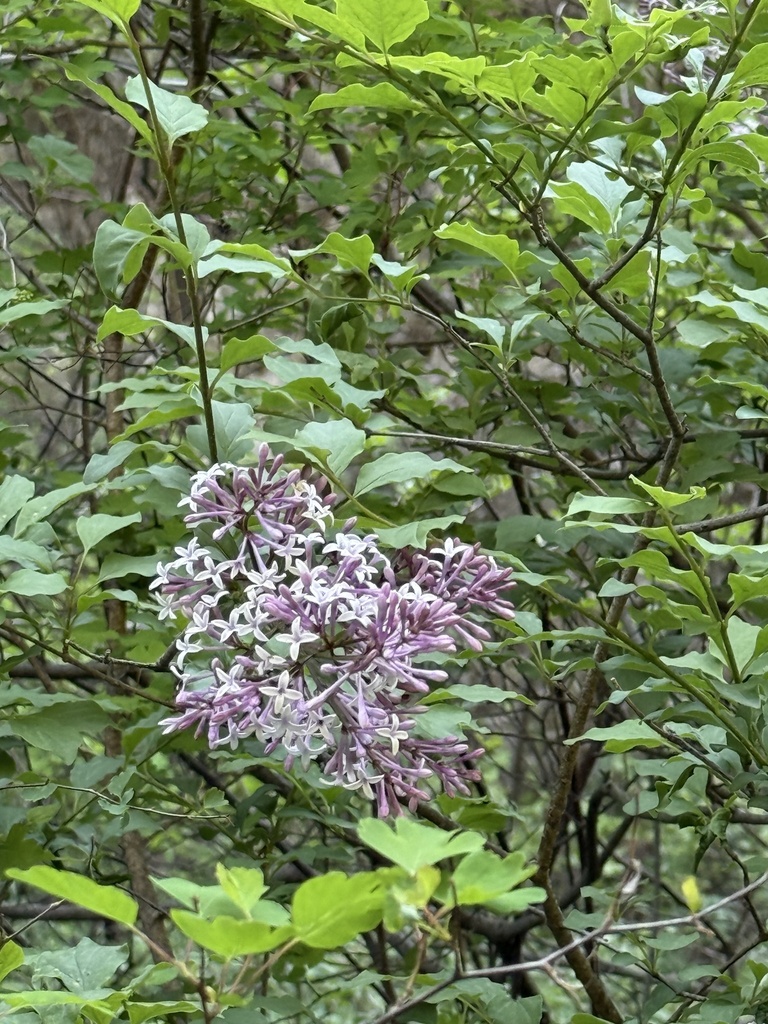
Enter your ZIP to see whether this is legal to plant in your state, and whether it survives your winter.
Daphne lilac is rated fire resistant on limited evidence from Ohio and Alaska, with care and placement qualifying Alaska's guidance.
Ohio State University Extension assigns Syringa meyeri an L flammability grade. In its five-band scale, this sits above very low and below medium. The assessment rests on the authors' experience. The same description notes urban tolerance and disease sensitivity, providing horticultural context alongside the favorable fire grade.
Alaska's forestry agency lists Syringa meyeri under dwarf lilacs. It allows the listed examples in firewise landscapes when they receive appropriate placement and maintenance. That condition is part of Alaska's recommendation, not a separate favorable rating of an unattended shrub.
For this lilac, the two sources point in the same direction. Ohio supplies an explicit low-flammability grade, while Alaska describes a conditional use in its landscapes. Together they support the fire-resistant classification, with the regional placement-and-care requirement retained whenever the Alaska advice is used.
Form
shrub
Rated in
Alaska; Ohio / Midwest
Uses
specimen, mass-planting, hedge
On this lot
1. Fire evidence and conditions
Fire evidence
Fire-resistant — location does not change the cited classification.
Alaska Division of Forestry opens with the wildfire threat to Alaskans and publishes Alaska firewise-landscape examples. FireApproved publishes 58 exact source owners from its 60 taxon entries and holds the taxon-free fern label. State publication scope does not establish suitability for every Alaska climate, site, or home-ignition-zone placement.
Ohio State University Extension Bulletin 921 is an Ohio publication that describes Ohio fire seasons and landscape conditions and labels nativity to Ohio. FireApproved publishes 352 exact source-owning plant records from its eight rated tables. This historical publication scope does not assert current extension endorsement or that a listed plant suits every Ohio site.
2. Why this plant is relevant here
State distribution
Documented in OH.
Native range
Introduced / established
USDA hardiness
3. Legal, ecological, and broader status
Legal-list status
Seed-list status
Reported invasive here
Broader regional context
Federal context
How to read this page
The status above is computed from the cited rows below: independent recommendations can support a fire-resistant result, an avoid row can produce keep-away, and disagreement stays visible as conflict. Placement notes preserve each source’s own scheme rather than translating unlike rules into one scale. This is evidence about a plant, not permission to plant it in every part of the defensible space; Zone 0 remains noncombustible.
Where its sources say to plant it
Placement rules below use each source's own distances or named zones, tied to its rating.
They are not interchangeable with the directory's current Zone 0 guidance.
Protect Your Home from Wildfire: Shrubs [Alaska DNR brochure sections] (with its recommendation)
The evidence
Grouped by what each source concluded. Primary evidence rated the plant itself
(a lab, field program, or original curation); corroboration compiled or
republished another source's rating and resolves to its root lineage.
“Following are a few of the plants that may be used in firewise landscapes in Alaska if placed and maintained appropriately.”
Listed as Lilac, dwarf varieties — Syringa meyeri; Lilac, dwarf varieties — S. patula; the source conditions these examples on appropriate placement and maintenance.