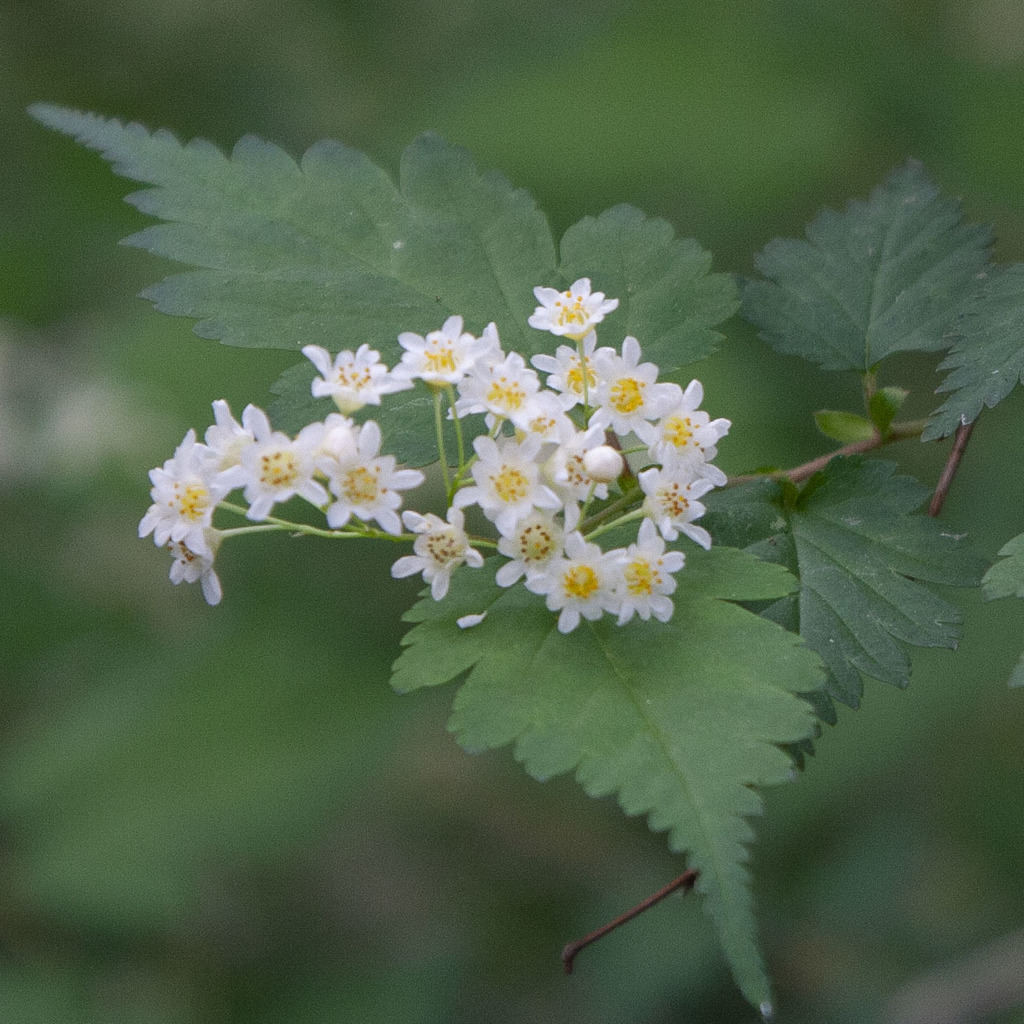
United States / Grow / laceshrub

laceshrub (Stephanandra incisa)
Photo: (c) Timur Kalininsky, some rights reserved (CC BY) (CC BY), via iNaturalist. Species-typical, not necessarily this cultivar.

laceshrub

Stephanandra incisa (accepted: Neillia incisa) · Rosaceae · also called Cutleaf Stephanandra · Wikipedia

View Saved

Is this one for your yard?

Enter your ZIP to see whether this is legal to plant in your state, and whether it survives your winter.

Cutleaf Stephanandra is listed for fire-resistant landscaping, but a durable hedge and a low fire grade do not settle its planting conditions.

Ohio’s historical bulletin gives Stephanandra incisa L, meaning Low flammability. The Eastern U.S. selector assigns At Risk and marks ladder potential without pruning Yes. Its heading uses the source spelling Stephandra incisa.

The selector praises playground hedges for resisting breakage when fallen into. That durability does not establish playground fire safety. It records a mature height of 4 feet.

Growing conditions also need their own attribution. Ohio requires acid soil and calls the shrub urban adaptive. The selector records adaptable soil pH, low tolerance of poor drainage and high drought resistance. Neither description explains the grade difference.

Ohio allows low-rated deciduous shrubs judiciously in foundation plantings, with dead-material removal and spacing that prevents ladder fuels reaching roofs or trees. Its use code Sp means Specimen; the row’s M is undefined in that legend and supplies no mass-planting permission.

For high-fire-risk sites, the selector assigns this shrub LZ2. Both frameworks define Zone 2 as 5 to 10 feet from the house, with lawn, avoidance of readily ignitable fast-burning evergreens, and fuel breaks such as raised beds, rock gardens, paths, walls or patios. Their tree-crown gap is 10 to 15 feet. Ohio keeps these trees small and at least 10 feet from the house; the selector requires that mature clearance vertically and horizontally. These are tree rules. The selector's general mature-plant minimum is 2 feet from structures; its foundation guidance is for plants below 18 inches, at least 1 foot away. The recorded shrub exceeds that height condition.

Ohio’s Zone 1 extends to 5 feet, keeping flammable material away from the house. Its Zone 3 spans 10 to 30 feet: debris removal and thinning reach at least 30 feet, extended to 100 feet downhill on slopes. Keep shrubs small and free of dead material; control brush and weeds annually. Steep slopes can be terraced. In this zone, the tree-crown gap above is a minimum.

Continued care includes clearing leaves, needles and twigs, removing dead, diseased, crossing and low branches, and maintaining horizontal and vertical separation. Watering and pruning must prevent deadwood accumulation. At Risk alone does not impose a removal order.

Form
shrub
Rated in
Ohio / Midwest; eastern US
Uses
specimen, mass-planting
On this lot

1. Fire evidence and conditions

Fire evidence
Fire-resistant — location does not change the cited classification.
Placement evidence
1 source placement record; source schemes remain separate.
Evidence regions
Ohio / Midwest; eastern US
Typed publication scope: 1 scope across 1 cited fire source
  • Firewise Landscaping (OSU Extension Bulletin 921) · Official scoped edition
    • OH; partial normalized coverage · 2006-03-01

      Ohio State University Extension Bulletin 921 is an Ohio publication that describes Ohio fire seasons and landscape conditions and labels nativity to Ohio. FireApproved publishes 352 exact source-owning plant records from its eight rated tables. This historical publication scope does not assert current extension endorsement or that a listed plant suits every Ohio site.

2. Why this plant is relevant here

State distribution
Documented in DC, DE, MD, NJ, OH, PA, VA, WV.
Introduced / established
1 sourced range or established record. This is not an invasive warning.
USDA hardiness
Only uncertain or inapplicable hardiness rows are cited; no primary zone is projected.

3. Legal, ecological, and broader status

How to read this page

The status above is computed from the cited rows below: independent recommendations can support a fire-resistant result, an avoid row can produce keep-away, and disagreement stays visible as conflict. Placement notes preserve each source’s own scheme rather than translating unlike rules into one scale. This is evidence about a plant, not permission to plant it in every part of the defensible space; Zone 0 remains noncombustible.

Plant hardiness evidence

These values describe the plant source. Your ZIP zone comes from the separate 2023 USDA Plant Hardiness Zone Map. Whole-zone values stay whole-zone, and a single unresolved value is not treated as a tolerance range. Different source boundaries stay separate: overlapping statements are compared independently, while only ranges with no shared zone are called a conflict.

Where its sources say to plant it

Placement rules below use each source's own distances or named zones, tied to its rating. They are not interchangeable with the directory's current Zone 0 guidance.

The evidence

Grouped by what each source concluded. Primary evidence rated the plant itself (a lab, field program, or original curation); corroboration compiled or republished another source's rating and resolves to its root lineage.

Recommends (1)

Mid-scale / conditional (1)

Last verified 2026-08-24. JSON (CC BY 4.0)

Profiles: USDA PLANTS · GBIF · Wikidata · Wikipedia · ITIS

Stephanandra incisa (Cutleaf Stephanandra). FireApproved. https://fireapproved.com/plants/stephanandra-incisa/. Last verified 2026-08-24.