Enter your ZIP to see whether this is legal to plant in your state, and whether it survives your winter.
Japanese pagoda tree is rated fire resistant overall, although the sources do not all describe it as a top performer.
Four of six assessments recommend it. Ohio State’s extension service gives it L, the low band on a five-point flammability scale. FireSmart BC approves it as fire resistant while flagging the species for more research. Valencia recommends it as a low-flammability tree for gardens near wildland, and Girona’s fire-adapted gardening guide rates it “recommended.” Girona’s judgment is broader than a simple burn test: its method also weighs fuel structure, maintenance, origin, invasiveness, and fire-service experience.
The remaining findings temper that agreement rather than reverse it. The eastern US Firewise selector rates Japanese pagoda tree 2 on its four-point scale, meaning “Moderately Firewise,” one step below its best category. A Japanese classification places it in the small fire-protection-power class; that scale reserves stronger ratings for trees judged better able to slow fire spread, carry heat and smoke upward, and intercept flying embers.
Taken together, the findings support Japanese pagoda tree as a fire-resistant choice, but not as one of the strongest fire-protection trees. It is a roughly 40-foot tree in the pea family, suited to full sun and hardy to USDA zone 5a. Fire resistance still does not make any tree fireproof, and the research caution from FireSmart BC is reason to keep the conclusion measured.
Form
tree
Mature height
~40 ft
Light
Full sun
Rated in
British Columbia; Catalonia, Spain; Global; Japan +3
On this lot
1. Fire evidence and conditions
Fire evidence
Fire-resistant — location does not change the cited classification.
Ohio State University Extension Bulletin 921 is an Ohio publication that describes Ohio fire seasons and landscape conditions and labels nativity to Ohio. FireApproved publishes 352 exact source-owning plant records from its eight rated tables. This historical publication scope does not assert current extension endorsement or that a listed plant suits every Ohio site.
2. Why this plant is relevant here
State distribution
Documented in DC, DE, MD, NC, NJ, NY, OH, PA, VA, WV.
Native range
Introduced / established
USDA hardiness
Only uncertain or inapplicable hardiness rows are cited; no primary zone is projected.
3. Legal, ecological, and broader status
Legal-list status
Seed-list status
Reported invasive here
1 ecological invasive report.
Broader regional context
Federal context
How to read this page
The status above is computed from the cited rows below: independent recommendations can support a fire-resistant result, an avoid row can produce keep-away, and disagreement stays visible as conflict. Placement notes preserve each source’s own scheme rather than translating unlike rules into one scale. This is evidence about a plant, not permission to plant it in every part of the defensible space; Zone 0 remains noncombustible.
Plant hardiness evidence
These values describe the plant source. Your ZIP zone comes from the separate 2023 USDA
Plant Hardiness Zone Map. Whole-zone values stay whole-zone, and a single unresolved value
is not treated as a tolerance range. Different source boundaries stay separate: overlapping
statements are compared independently, while only ranges with no shared zone are called a conflict.
Source prints 5 · single-value meaning unresolved · whole zone precision · source stated
Source taxon: Sophora japonica · exact match.
Source location: Cold Hardiness Zone field in the recovered selector record.
Not used for comparison: The recovered selector prints one Cold Hardiness Zone value but does not define it as a minimum threshold or a one-zone range.
Where its sources say to plant it
Placement rules below use each source's own distances or named zones, tied to its rating.
They are not interchangeable with the directory's current Zone 0 guidance.
Eastern United States Fire Performance Plant Selector: Landscape Zone 3 — 10–30 ft from the structure; thin vegetation, remove debris, and minimize plant massing [Fire Performance Plant Selector landscape zone] (mid-scale rating)
Guía de pirojardinería: suitable inside or outside the 25-metre maximum-risk zone [girona-2020-iuf-25m-suitability] (with its recommendation)
Tree fire-protection classification in Hito to Shinrin: エンジュ — Table 10-2 [tadaki-kira-1982-fire-protection-power] (mid-scale rating)
The evidence
Grouped by what each source concluded. Primary evidence rated the plant itself
(a lab, field program, or original curation); corroboration compiled or
republished another source's rating and resolves to its root lineage.
Styphnolobium japonicum is rated “RECOMENDADA” by the guide's qualitative IUF garden-suitability method. The method assumes species-specific care and integrates fire evidence with fuel structure, maintenance, origin, invasiveness, and expert fire-service experience.
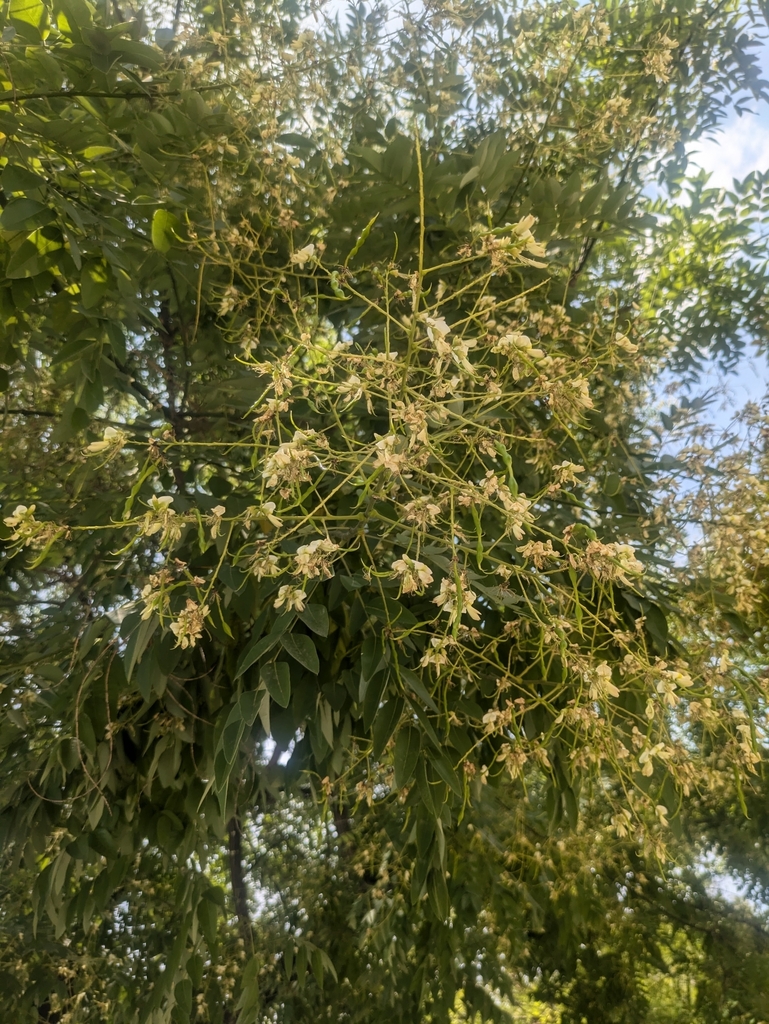
White pea-like flowers. Seed pods tend to be more like a string of perals. Not for human consumption.
Tree fire-protection classification in Hito to Shinrin (人と森林) — Kyoritsu Shuppan; table reproduced by Kagoshima Prefecture · Hito to Shinrin (1982), Table 10-2; Kagoshima web reproduction · original sourcePrimary evidenceExpert-curatedlineage: independent (root of Japanese municipal fire-protection tree lists)
Table 10-2 prints エンジュ in the small fire-protection-power class. The Kagoshima reproduction says highly fire-protective trees can slow spread, promote upward dispersal of heat and smoke, and intercept flying embers.
Listed without a rating (1)Corroboration (1 rows from 1 source)
FLAMITS record 13732; Combustibility measurement; plant part leaves; fuel live; predrying yes; device calorimeter; site Wang2009-1; sampling november. Primary study Wang2009: Wang, X., Niu, S., & Kan, Z. (2009). Properties and flammability of major tree species in the Beijing area. Frontiers of Forestry in China, 4, 304-308.