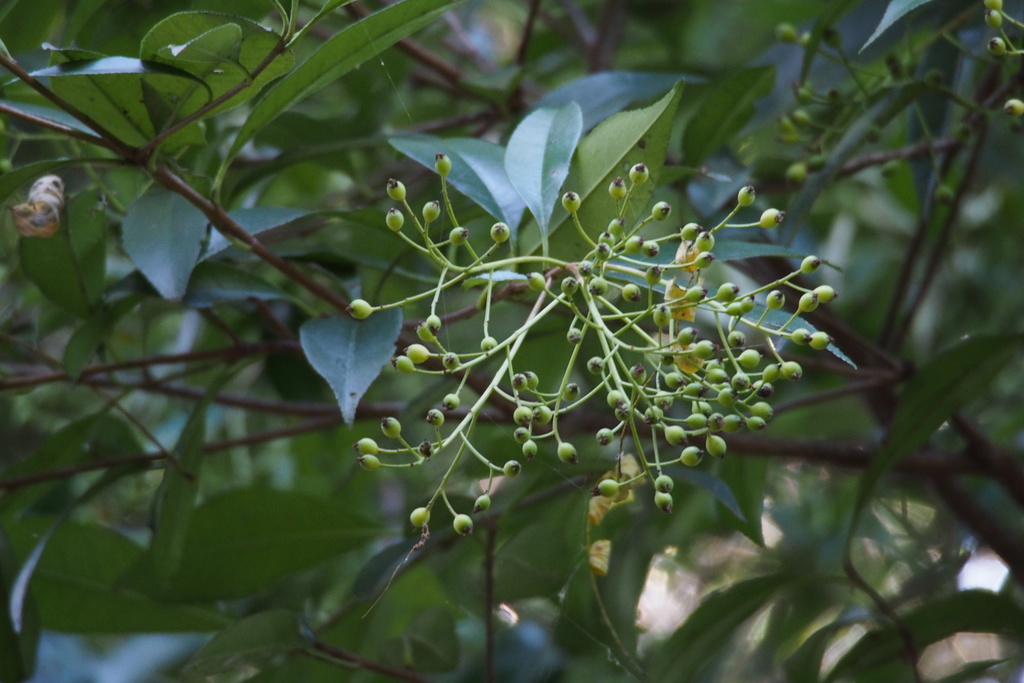
Photinia glabra var. rubens (accepted: Photinia glabra) · Rosaceae · all Photinia records · also called Chinese fire bush, Red-leafed photinia · Wikipedia
The Place chip compares this record with your lot.
Enter your ZIP to see whether this is legal to plant in your state, and whether it survives your winter.
Japanese photinia is rated fire resistant overall, but the evidence is limited and one fire service calls it moderately flammable.
Japanese and Australian guidance provide the favorable case. A table published by Kyoritsu Shuppan places Japanese photinia in its highest of four fire-protection classes. Kagoshima Prefecture’s reproduction explains that highly fire-protective trees can slow fire spread, direct heat and smoke upward, and intercept flying embers. The ACT Government’s plant selector also marks Photinia glabra ‘Rubens’ as fire retardant.
The caution comes from the Tasmania Fire Service, which assigns the shrub moderate flammability and advises avoiding plants in that group within the Building Protection Zone. That rating does not erase the favorable classifications, but it argues against treating “fire resistant” as meaning safe in every position.
A laboratory observation adds context without deciding the verdict. Predried branches ignited in 87.5 percent of grill trials recorded in the FLAMITS database. FLAMITS preserves measurements made with different plant parts, devices, and methods without applying a single threshold that turns them into recommendations. Taken together, the findings support calling Japanese photinia fire resistant on limited primary evidence, while the Tasmanian guidance gives good reason to keep placement and local rules in view.
Form
shrub
Rated in
Australian Capital Territory, Australia; Global; Japan; Tasmania, Australia
On this lot
1. Fire evidence and conditions
Fire evidence
Fire-resistant — location does not change the cited classification.
Australian Capital Territory, Australia; Global; Japan; Tasmania, Australia
Maintenance
2. Why this plant is relevant here
State distribution
Documented in LA.
Native range
Introduced / established
USDA hardiness
3. Legal, ecological, and broader status
Legal-list status
Seed-list status
Reported invasive here
Broader regional context
Federal context
How to read this page
The status above is computed from the cited rows below: independent recommendations can support a fire-resistant result, an avoid row can produce keep-away, and disagreement stays visible as conflict. Placement notes preserve each source’s own scheme rather than translating unlike rules into one scale. This is evidence about a plant, not permission to plant it in every part of the defensible space; Zone 0 remains noncombustible.
Where its sources say to plant it
Placement rules below use each source's own distances or named zones, tied to its rating.
They are not interchangeable with the directory's current Zone 0 guidance.
Fire Resisting Garden Plants for the Urban Fringe and Rur…: should be avoided in the Building Protection Zone [Texas Building Protection Zone] (mid-scale rating)
Tree fire-protection classification in Hito to Shinrin: カナメモチ — Table 10-2 [tadaki-kira-1982-fire-protection-power] (with its recommendation)
Canberra Plant Selector: filtered result page 15 [canberra-selector] (with its recommendation)
The evidence
Grouped by what each source concluded. Primary evidence rated the plant itself
(a lab, field program, or original curation); corroboration compiled or
republished another source's rating and resolves to its root lineage.
Recommends (2)
Tree fire-protection classification in Hito to Shinrin (人と森林) — Kyoritsu Shuppan; table reproduced by Kagoshima Prefecture · Hito to Shinrin (1982), Table 10-2; Kagoshima web reproduction · original sourcePrimary evidenceExpert-curatedlineage: independent (root of Japanese municipal fire-protection tree lists)
Table 10-2 prints カナメモチ in the large fire-protection-power class. The Kagoshima reproduction says highly fire-protective trees can slow spread, promote upward dispersal of heat and smoke, and intercept flying embers.
4 cited rows from this source; its identity, lineage and tier are stated once.
Primary study Cui2020a: Cui, X., Paterson, A. M., Wyse, S. V., Alam, M. A., Maurin, K. J. L., Pieper, R., ... Curran, T. J. (2020a). Shoot flammability of vascular plants is phylogenetically conserved and related to habitat fire-proneness and growth form. Nature Plants, 6, 355-359.
Shared row context: plant part branches; fuel all; predrying yes; device grill; site Cui2020a-1; sampling ND.
Photinia glabra var. rubens (Chinese fire bush, Red-leafed photinia). FireApproved. https://fireapproved.com/plants/photinia-glabra/. Last verified 2026-08-23.