Enter your ZIP to see whether this is legal to plant in your state, and whether it survives your winter.
Persian ironwood is rated fire resistant, with Girona's recommendation and the Eastern U.S.
selector's moderate grade carrying different siting rules.
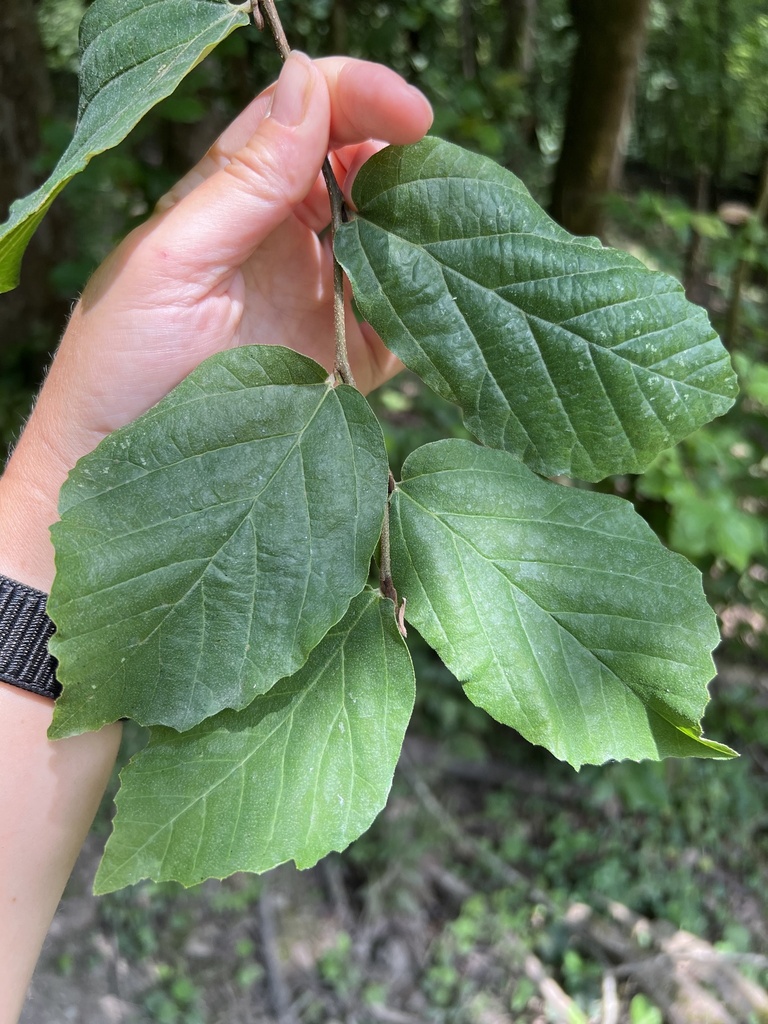
Girona's 2020 guide recommends Parrotia persica for the urban–forest interface. Its suitability judgment combines fire literature, fuel structure, maintenance and expert experience. Recommended plants may occupy either side of its 25-metre maximum-risk boundary around a dwelling, but trees near the house should stand individually without continuity with other vegetation. Groves belong outside that zone, at least 25 metres from the façade. The guide describes low irrigation and pruning frequency for this deciduous tree, with fertile, well-drained acidic soil and tolerance of alkaline or calcareous ground. Those relative care labels do not remove the arrangement requirements.
For high-fire-risk sites, the historical Eastern U.S. selector places this tree in Landscape Zone 3: the area 10 to 30 feet from the house. Its Moderately Firewise grade accompanies a Yes for ladder potential without pruning. That pairing calls for maintained tree spacing, including a minimum of 10 to 15 feet between crowns. Clear yard debris and thin vegetation through the first 30 feet; on a slope, extend that work to 100 feet downhill. Driveways can break up fuel, while terracing may slow spread depending on wind and available fuel. LZ3 allows low and moderately flammable plants, but calls for minimized massing, annual mowing of brush and weeds, and selection of shrubs and groundcovers by mature height.
These instructions describe a maintained planting, not a one-time choice of species. The selector calls for clearing dead leaves, needles and twigs, cutting out low, dead or diseased branches, and retaining separation both above and beside plants. Watering and pruning must keep deadwood from accumulating on plants or underneath them. Its general minimum of 2 feet between mature vegetation and structures does not replace this tree's LZ3 assignment. For Persian ironwood, the practical task is to plan the mature tree's position and the vegetation surrounding it together. Girona's suitability and the Eastern selector's zone are separate historical approaches; neither supplies a universal legal setback.
Form
tree
Mature height
~50 ft
Light
Full sun
Rated in
Catalonia, Spain; eastern US
On this lot
1. Fire evidence and conditions
Fire evidence
Fire-resistant — location does not change the cited classification.
Only uncertain or inapplicable hardiness rows are cited; no primary zone is projected.
3. Legal, ecological, and broader status
Legal-list status
Seed-list status
Reported invasive here
Broader regional context
Federal context
How to read this page
The status above is computed from the cited rows below: independent recommendations can support a fire-resistant result, an avoid row can produce keep-away, and disagreement stays visible as conflict. Placement notes preserve each source’s own scheme rather than translating unlike rules into one scale. This is evidence about a plant, not permission to plant it in every part of the defensible space; Zone 0 remains noncombustible.
Plant hardiness evidence
These values describe the plant source. Your ZIP zone comes from the separate 2023 USDA
Plant Hardiness Zone Map. Whole-zone values stay whole-zone, and a single unresolved value
is not treated as a tolerance range. Different source boundaries stay separate: overlapping
statements are compared independently, while only ranges with no shared zone are called a conflict.
Source prints 5 · single-value meaning unresolved · whole zone precision · source stated
Source taxon: Parrotia persica · exact match.
Source location: Cold Hardiness Zone field in the recovered selector record.
Not used for comparison: The recovered selector prints one Cold Hardiness Zone value but does not define it as a minimum threshold or a one-zone range.
Where its sources say to plant it
Placement rules below use each source's own distances or named zones, tied to its rating.
They are not interchangeable with the directory's current Zone 0 guidance.
Eastern United States Fire Performance Plant Selector: Landscape Zone 3 — 10–30 ft from the structure; thin vegetation, remove debris, and minimize plant massing [Fire Performance Plant Selector landscape zone] (mid-scale rating)
Guía de pirojardinería: suitable inside or outside the 25-metre maximum-risk zone [girona-2020-iuf-25m-suitability] (with its recommendation)
The evidence
Grouped by what each source concluded. Primary evidence rated the plant itself
(a lab, field program, or original curation); corroboration compiled or
republished another source's rating and resolves to its root lineage.
Parrotia persica is rated “RECOMENDADA” by the guide's qualitative IUF garden-suitability method. The method assumes species-specific care and integrates fire evidence with fuel structure, maintenance, origin, invasiveness, and expert fire-service experience.