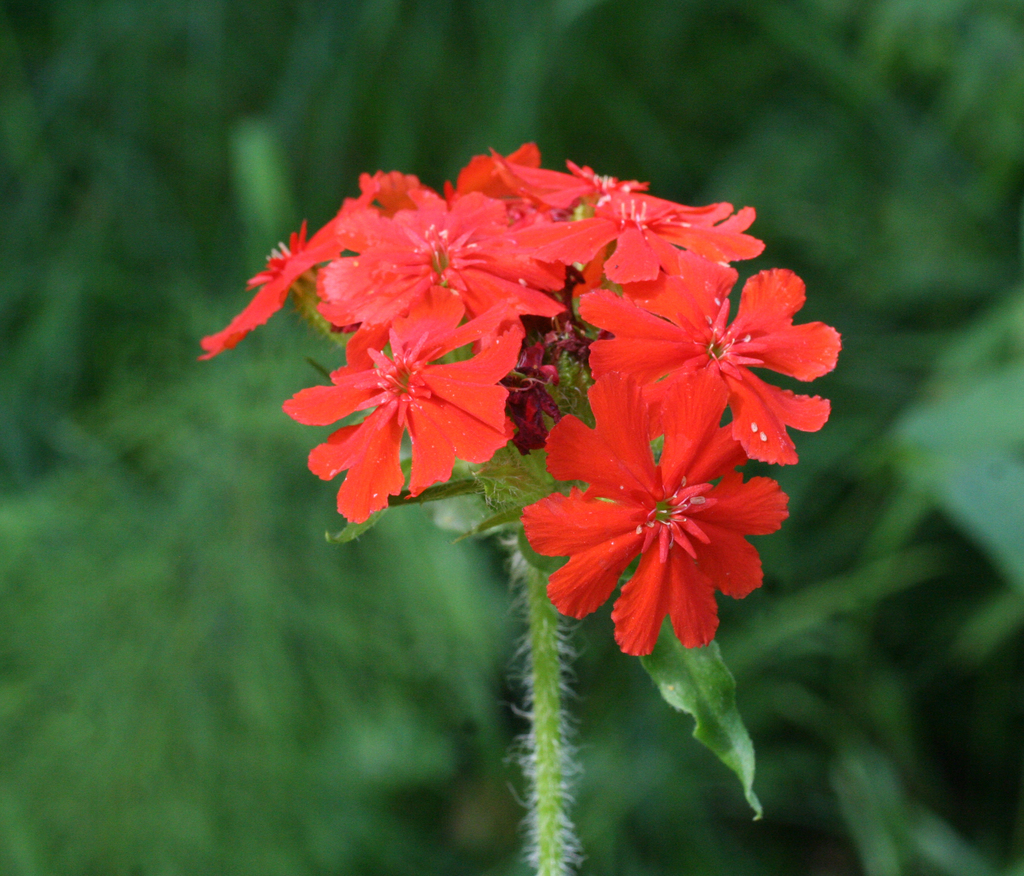
maltesecross
Lychnis chalcedonica
A genus split is not a placement verdict.
Is this one for your yard?
Enter your ZIP to see whether this is legal to plant in your state, and whether it survives your winter.
Maltese cross is recommended for Michigan's climate on MSU's wildfire-resistant list, with nativity and regional ecology recorded separately.
Michigan State University Extension's January 2007 bulletin lists Lychnis chalcedonica as a herbaceous perennial for winter-hardiness zones 3–7. Its separate “Native to Mich.” column says No. The recommendation concerns a regional planting list; the hardiness interval concerns average low winter temperatures. Neither makes the species Michigan-native, and heat, humidity, soil and water still affect climatic suitability.
The United States Register of Introduced and Invasive Species, version 2.0 from November 2022, uses the accepted name Silene chalcedonica and explicitly gives Lychnis chalcedonica as another name. Its Alaska record assigns invasive category D2; its separate conterminous-US record assigns widespread-invasive category E. These are ecological categories, not sale restrictions or fire measurements. The conterminous-US designation is an aggregate finding, not a Michigan-specific invasive determination. The ecology records address a different question from MSU's climate and wildfire-resistance selection.
MSU places its selection within a maintained landscape. It calls for at least 3 feet between structures and landscape plants, using mineral soil, limestone or marble chips rather than organic mulch, peat or wood chips in that barrier. Allow at least 30 feet between structures and solid wildland vegetation. Ornamental plants may occupy that space, with 10–16 feet between their crowns. At a hill crest, the downhill defensible space extends at least 60 feet; LP tanks, firewood and other fuels belong outside the applicable perimeter. Plan for mature plant size, keep lawns mowed and watered, remove or compost dead lawn litter, and clear leaves from eave troughs and the home's base. The bulletin's tree-pruning directions concern trees, not this perennial.
A separate footnote describes Michigan's critical-dune guidelines in 2007: only native plants within 100 feet of a dune crest, with a permit required for any lake-side alteration, including establishing or reestablishing vegetation. That historical condition is distinct from the table's No nativity entry. MSU also warns that any plant can burn when tissue becomes very dry under intense heat over time. Its recommendation therefore combines species selection with placement and care, rather than establishing combustion performance or present-day dune permission.
- Form
- perennial
- Rated in
- Michigan / Great Lakes