United States / Grow / Threeawns
Threeawns
Threeawns include keep-away choices: purple threeawn and pineland threeawn have explicit unfavorable fire assessments.
Girona's 2020 fire-prevention gardening guide marks purple threeawn (Aristida purpurea) not recommended. Its assessment concerns garden suitability and combines fire evidence with fuel structure, maintenance and other plant characteristics. It is broader than a measurement of how quickly one sample ignites.
For pineland threeawn (Aristida stricta), North Carolina's 2005 landscaping guide used the extreme-flammability class; its 2025 successor places the species in the high-flammability table. The Forest Service's review explains a physical concern: abundant, fibrous leaves and a high proportion of dead foliage make this species highly flammable. Burning its stands tends to remove the aboveground growth.
That same review describes pineland threeawn as adapted to fire, with growing points protected below the soil surface. Fire adaptation therefore coexists with highly flammable foliage in this grass. Its ability to persist in a fire-shaped ecosystem should not be mistaken for low fuel flammability beside a home.
Keep away: 3 species
- purple threeawn Keep away Aristida purpurea
-
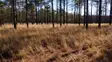 pineland threeawn Keep away Aristida stricta
 - sixweeks threeawn Keep away Aristida adscensionis
Awaiting evidence: 8 species
- Aristida erecta Awaiting evidence Aristida erecta
- Aristida setifolia Awaiting evidence Aristida setifolia
- Aristida mendocina Awaiting evidence Aristida mendocina
- Spreading Prickle Grass Awaiting evidence Aristida congesta
- Aristida riparia Awaiting evidence Aristida riparia
- Aristida rufescens Awaiting evidence Aristida rufescens
- Aristida tenuissima Awaiting evidence Aristida tenuissima
- Erect Kerosene Grass Awaiting evidence Aristida holathera
About threeawns
Directory notes
More about Aristida: Wikipedia — external references; not evidence sources.
The answer for threeawns is no. Here is what to plant instead.
Alternatives matched by form and place, each carrying its own evidence.