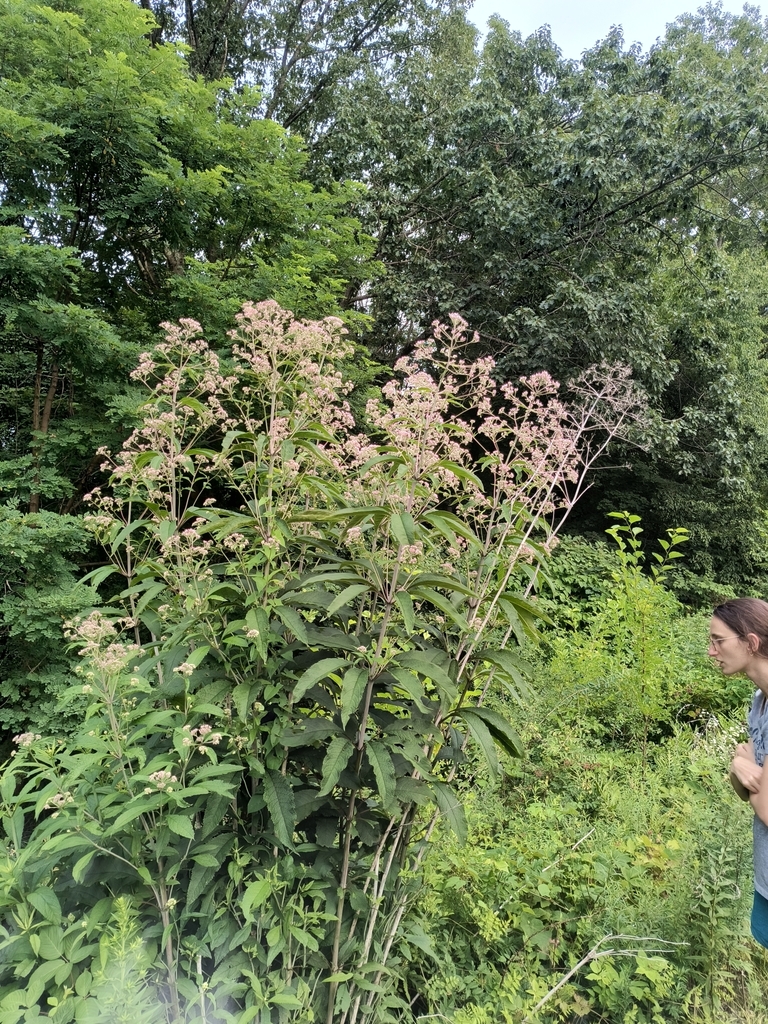
Photo: no rights reserved (CC0),
via iNaturalist. Species-typical, not necessarily this cultivar.
trumpetweed
Eupatorium fistulosum (accepted: Eutrochium fistulosum) · Asteraceae · all Eupatorium records · also called Joe-pye-weed · syn. Eupatorium fistulosum · Wikipedia
The Place chip compares this record with your lot.
Enter your ZIP to see whether this is legal to plant in your state, and whether it survives your winter.
Trumpetweed is rated fire resistant, with low-flammability findings in North Carolina and a fire-resistant listing in Oregon.
North Carolina’s extension service has repeatedly placed trumpetweed in its lowest flammability class. The 2005 assessment, prepared with the US Fish and Wildlife Service, used a four-level scale from low to extreme. Its 2025 successor uses low, medium and high classes, again rating the plant low. The live Extension Gardener Plant Toolbox supplies a third low-flammability finding. These are expert-curated recommendations rather than measurements of a single leaf or stem.
Oregon State’s extension service reaches the same practical conclusion through a different system. Its Willamette Valley guide profiles plants recommended as fire resistant for local growing conditions, and includes trumpetweed under the name Eutrochium fistulosum, or Joe Pye Weed. Across four assessments, none places it in a conflicting category.
Trumpetweed has high water needs. This perennial in the aster family reaches about six feet at maturity. It is hardy to USDA zone 4a, while Oregon’s profile prints a zone range of 4 through 9. The consistent low-flammability and fire-resistant recommendations make it a supported choice for fire-conscious landscaping where its water needs and mature size suit the site.
Form
perennial
Mature height
~6 ft
Water need
high
Rated in
NC; North Carolina; North Carolina / southeastern US; Oregon (Willamette Valley)
On this lot
1. Fire evidence and conditions
Fire evidence
Fire-resistant — location does not change the cited classification.
The complete three-table AG-874 plant list is explicitly for North Carolina and contains 202 low-, medium-, or high-flammability rows. FireApproved accounts for all source rows under its strict taxonomy and lineage rules; source scope does not establish local suitability at a particular North Carolina site.
Willamette Valley (OR footprint); partial normalized coverage · 2015-02-01
OSU Extension says EM 9103 highlights fire-resistant plants that thrive under Willamette Valley growing conditions. FireApproved publishes 172 exact owners only as valley context. The guide shares the PNW 590 lineage and is not a second independent vote or statewide site clearance.
2. Why this plant is relevant here
State distribution
Documented in AL, AR, CT, DC, DE, FL, GA, IL, IN, KY, LA, MA, MD, ME, MI, MO, MS, NC, NH, NJ, NY, OH, OK, PA, RI, SC, TN, TX, VA, VT, WV.
Native range
The legacy compatibility field lists NC in native range; its field-level source was not retained.
Introduced / established
USDA hardiness
2 applicable cited hardiness statements overlap but have different boundaries; compare each complete source row.
3. Legal, ecological, and broader status
Legal-list status
Seed-list status
Reported invasive here
Broader regional context
Federal context
How to read this page
The status above is computed from the cited rows below: independent recommendations can support a fire-resistant result, an avoid row can produce keep-away, and disagreement stays visible as conflict. Placement notes preserve each source’s own scheme rather than translating unlike rules into one scale. This is evidence about a plant, not permission to plant it in every part of the defensible space; Zone 0 remains noncombustible.
Plant hardiness evidence
These values describe the plant source. Your ZIP zone comes from the separate 2023 USDA
Plant Hardiness Zone Map. Whole-zone values stay whole-zone, and a single unresolved value
is not treated as a tolerance range. Different source boundaries stay separate: overlapping
statements are compared independently, while only ranges with no shared zone are called a conflict.
Source location: PlantCharacteristics record 35639, Temperature, Minimum (°F).
Where its sources say to plant it
Placement rules below use each source's own distances or named zones, tied to its rating.
They are not interchangeable with the directory's current Zone 0 guidance.
Fire-resistant Landscape Plants for the Willamette Valley: Joe Pye Weed profile (PDF page 58) [osu-em-9103-profile] (with its recommendation)
North Carolina Extension Gardener Plant Toolbox: eutrochium-fistulosum [nc-toolbox-flammability-facet] (with its recommendation)
The evidence
Grouped by what each source concluded. Primary evidence rated the plant itself
(a lab, field program, or original curation); corroboration compiled or
republished another source's rating and resolves to its root lineage.