Enter your ZIP to see whether this is legal to plant in your state, and whether it survives your winter.
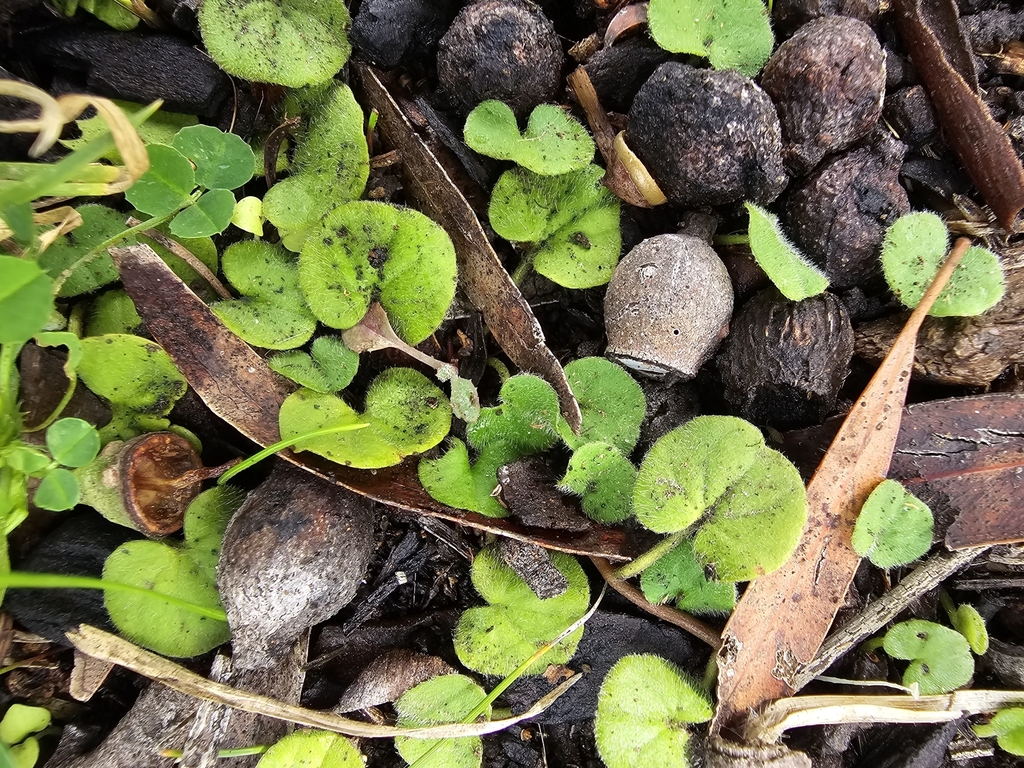
Yes, creeping dichondra is rated fire resistant by the balance of three independent sources.
Australian Plants Society Victoria calls creeping dichondra fire-retardant based on field trials. On its two-class scale, that means the plant resists the first wave of flame but may burn after drying out. The rating supports its use without suggesting that the plant cannot burn.
The Diputació de Girona and Catalonia’s fire service also rate Dichondra repens “recommended.” Their garden-suitability method combines fire research and fire-service experience with fuel structure, maintenance, origin, invasiveness, and species-specific care. The ACT Government’s Canberra Plant Selector adds a simpler finding, marking the species “Fire Retardant: Yes.”
These sources reach the same practical conclusion by different routes: one uses a field-trial class, another weighs several garden and fire factors, and the third supplies a positive selector attribute. Creeping dichondra, a shrub in the Convolvulaceae family, therefore has consistent support as a fire-resistant choice. Its clearest stated limitation is the Australian warning that dried material may still burn, so “fire resistant” should be understood as resistance to initial flame rather than immunity from fire.
Form
shrub
Region
Victoria, Australia
Rated in
Australian Capital Territory, Australia; Catalonia, Spain; Victoria, Australia
On this lot
1. Fire evidence and conditions
Fire evidence
Fire-resistant — location does not change the cited classification.
Australian Capital Territory, Australia; Catalonia, Spain; Victoria, Australia
Maintenance
2. Why this plant is relevant here
State distribution
Native range
Introduced / established
USDA hardiness
3. Legal, ecological, and broader status
Legal-list status
Seed-list status
Reported invasive here
Broader regional context
Federal context
How to read this page
The status above is computed from the cited rows below: independent recommendations can support a fire-resistant result, an avoid row can produce keep-away, and disagreement stays visible as conflict. Placement notes preserve each source’s own scheme rather than translating unlike rules into one scale. This is evidence about a plant, not permission to plant it in every part of the defensible space; Zone 0 remains noncombustible.
Where its sources say to plant it
Placement rules below use each source's own distances or named zones, tied to its rating.
They are not interchangeable with the directory's current Zone 0 guidance.
Guía de pirojardinería: suitable inside or outside the 25-metre maximum-risk zone [girona-2020-iuf-25m-suitability] (with its recommendation)
Canberra Plant Selector: filtered result page 10 [canberra-selector] (with its recommendation)
The evidence
Grouped by what each source concluded. Primary evidence rated the plant itself
(a lab, field program, or original curation); corroboration compiled or
republished another source's rating and resolves to its root lineage.
Dichondra repens is rated “RECOMENDADA” by the guide's qualitative IUF garden-suitability method. The method assumes species-specific care and integrates fire evidence with fuel structure, maintenance, origin, invasiveness, and expert fire-service experience.