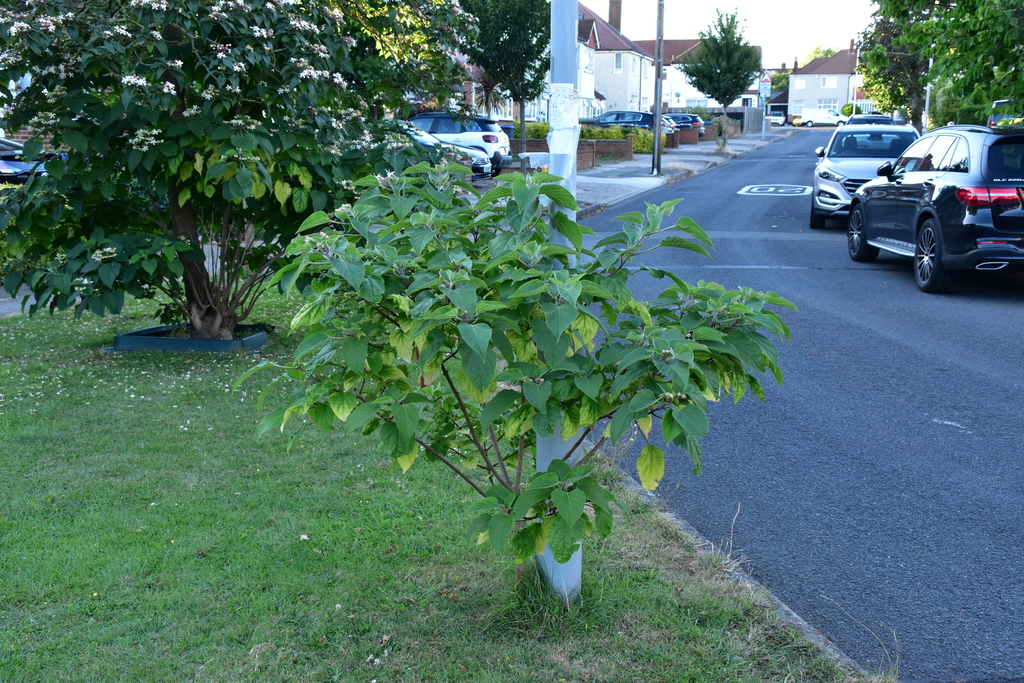
harlequin glorybower
Clerodendron trichotomum
A genus split is not a placement verdict.
Is this one for your yard?
Enter your ZIP to see whether this is legal to plant in your state, and whether it survives your winter.
Harlequin glorybower is rated fire resistant on Girona’s recommendation, which assumes optimal care, including frequent watering and pruning.
The historical Eastern United States selector makes its warning unusually direct: its description says “Very invasive,” and its Invasive field says Yes. It also gives an At Risk (3) Firewise grade and flags ladder potential without pruning. Those statements belong to that selector; they do not establish a present legal prohibition. Girona's favorable gardening verdict cannot cancel a warning made by a different source for a different region.
The 2020 Girona guide recommends Clerodendrum trichotomum within a qualitative assessment of gardens at the urban–forest interface. That assessment assumes optimal care for each species. Here, the required effort is visible in the species description: watering and pruning frequency are both high. The guide describes a deciduous shrub reaching 2–5 metres, in sun or partial shade, with loose, light, permeable soil. The recommendation therefore needs to be considered alongside the gardener's capacity to maintain those conditions.
The Eastern selector's note that it will grow on any site also needs its accompanying fields. The row specifies full sun, acidic soil, medium drought resistance and medium tolerance of poorly drained soils. Its height is 12 feet, separately printed as 3.6 metres. Neither the broad note nor these growing traits removes the source's invasive warning. Its general planting advice explicitly says to avoid invasive plants.
The selector's zone assignment still carries maintenance conditions. For high-fire-risk sites, the selector assigns Landscape Zone 2, covering 5–10 feet from a structure, and marks unpruned ladder potential Yes. Its care program calls for debris removal, pruning dead, diseased and low branches, and separation vertically and horizontally. Girona's shrub guidance calls for moderate use, isolated individuals and groups outside its risk zone. Its sentence about isolated shrubs combines “en zona de riesgo” with a minimum 25-metre distance from the façade, leaving an ambiguity that should not be converted into a single setback.
The practical comparison is between two regional recommendations with different limits. Girona supplies a favorable verdict with high maintenance demands; the Eastern selector supplies explicit fire and invasive cautions. Neither label alone settles this shrub's suitability for a particular garden.
- Form
- shrub
- Mature height
- ~12 ft
- Light
- Full sun
- Rated in
- Catalonia, Spain; eastern US