Enter your ZIP to see whether this is legal to plant in your state, and whether it survives your winter.
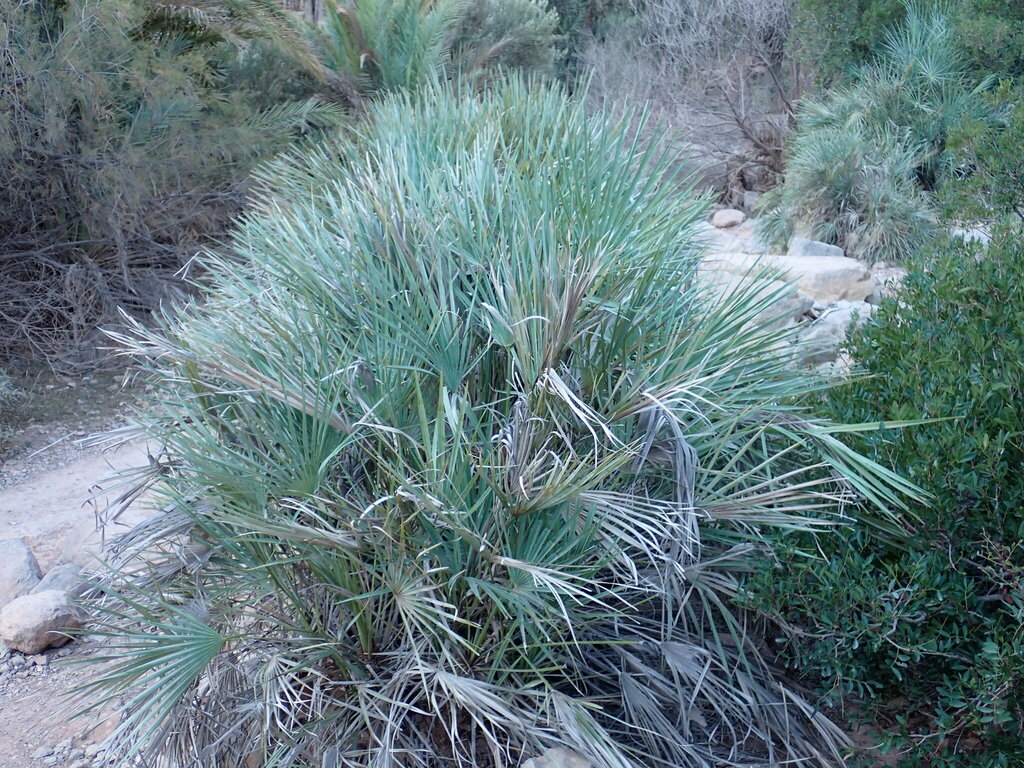
European fan palm is classified as fire resistant overall, but the California warning prevents treating it as a sure bet.
The Generalitat Valenciana recommends this shrub as a low-flammability species for gardens at the wildland-urban edge. Girona’s provincial government and Catalonia’s fire service recommend it assuming species-specific care; their garden-suitability method weighs fuel structure, maintenance, origin, and invasiveness alongside fire research and firefighters’ experience.
The contrary finding comes from the University of California Forest Products Laboratory. Its 1997 compilation says European fan palm was not recommended by three earlier references for high-fire-risk areas. That warning deserves attention, although the compilation itself cautions that its underlying lists often use undefined terms and lack a scientific basis.
Testing adds context without resolving the split. A European Scientific Journal study rated fresh material moderately flammable, meaning its ignition delay fell between 65 and 130 seconds under that study’s scale. A separate calorimeter measurement archived by Dryad found that leaves collected live and dried before testing released 4,678.99 kilocalories per kilogram. That calorific value describes heat released after ignition, not the plant’s overall suitability beside a home.
Form
shrub
Region
Algeria; Italy; Spain; Valencia, Spain
Rated in
California; Catalonia, Spain; Global; Tlemcen, western Algeria +1
On this lot
1. Fire evidence and conditions
Fire evidence
Fire-resistant — location does not change the cited classification.
The UC Forest Products Laboratory says the guide covers properties of common California landscaping plants and was prepared for California fire agencies. FireApproved publishes 130 exact owners at historical California publication scope. The report is a 1997 compilation, not a current endorsement, site rating, or independent test of every row.
2. Why this plant is relevant here
State distribution
Native range
Introduced / established
USDA hardiness
3. Legal, ecological, and broader status
Legal-list status
Seed-list status
Reported invasive here
Broader regional context
Federal context
How to read this page
The status above is computed from the cited rows below: independent recommendations can support a fire-resistant result, an avoid row can produce keep-away, and disagreement stays visible as conflict. Placement notes preserve each source’s own scheme rather than translating unlike rules into one scale. This is evidence about a plant, not permission to plant it in every part of the defensible space; Zone 0 remains noncombustible.
Conditions in the fire evidence
These describe tested or rated plant material. They are not horticultural maintenance instructions.
Placement rules below use each source's own distances or named zones, tied to its rating.
They are not interchangeable with the directory's current Zone 0 guidance.
Guía de pirojardinería: suitable inside or outside the 25-metre maximum-risk zone [girona-2020-iuf-25m-suitability] (with its recommendation)
The fire risk of the plant groupings with Cistus in the a…: Table 1 [henaoui-2013-fresh-material-flammability] (mid-scale rating)
Defensible Space Landscaping in the Urban/Wildland Interf…: Chapter 4, Landscape Vegetation Database [ucfpl-1997] (with its avoid rating)
The evidence
Grouped by what each source concluded. Primary evidence rated the plant itself
(a lab, field program, or original curation); corroboration compiled or
republished another source's rating and resolves to its root lineage.
Chamaerops humilis is rated “RECOMENDADA” by the guide's qualitative IUF garden-suitability method. The method assumes species-specific care and integrates fire evidence with fuel structure, maintenance, origin, invasiveness, and expert fire-service experience.
10 cited rows from this source; its identity, lineage and tier are stated once.
“calorific value (kcal/kg): 4678.99”
FLAMITS record 3937; Combustibility measurement; plant part leaves; fuel live; predrying yes; device calorimeter; site Gillon1997-1; sampling june to september. Primary study Gillon1997: Gillon, D., Hernando, C., Valette, J.-C., & Joffre, R. (1997). Fast estimation of the calorific values of forest fuels by near infrared-reflectance spectroscopy. Canadian Journal of Forest Research, 27, 760-765.
Primary study Henaoui2013: Henaoui, S. E. -A., Bouazza, M., & Amara, M. (2013). The fire risk of the plant groupings with Cistus in the area of Tlemcen (Western Algeria). European Scientific Journal, 9, 84-103.
Shared row context: plant part twigs; fuel live; predrying yes; device infrared burner; site Henaoui2013-1; sampling spring.
“flame height (cm): 24.96”
FLAMITS record 4878; Combustibility measurement.
“time to flaming (s): 69.42”
FLAMITS record 4916; Ignitability measurement.
“burning duration (s): 129.95”
FLAMITS record 4954; Sustainability measurement.
Primary study Molina2019: Molina, J., Lora, A., Prades, C., & Silva, F. R. (2019). Roadside vegetation planning and conservation: New approach to prevent and mitigate wildfires based on fire ignition potential. Forest ecology and management, 444, 163-173.
Shared row context: plant part leaves; fuel live; predrying no; device epiradiator; site Molina2019-1; sampling july and september.
Primary study Pellizzaro2007a: Pellizzaro, G., Duce, P., Ventura, A., & Zara, P. (2007). Seasonal variations of live moisture content and ignitability in shrubs of the Mediterranean Basin. International Journal of Wildland Fire, 16, 633-641.
Shared row context: Ignitability measurement; plant part twigs; fuel live; predrying no; device epiradiator; site Pellizzaro2007a-1; sampling october.
Chamaerops humilis (Mediterranean fan palm, European fan palm). FireApproved. https://fireapproved.com/plants/chamaerops-humilis/. Last verified 2026-08-23.