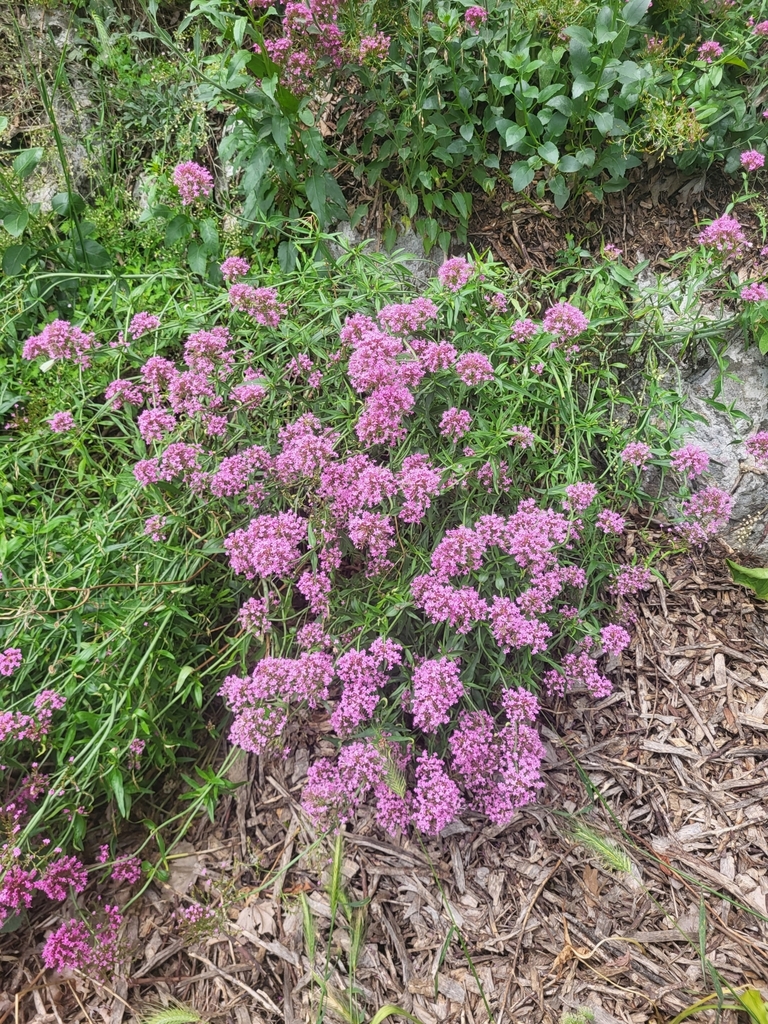
Enter your ZIP to see whether this is legal to plant in your state, and whether it survives your winter.
Red valerian is rated fire resistant, with all six sources reaching the same practical conclusion.
Idaho Firewise supplies the strongest numeric finding: a field trial gave red valerian a fire-resistance score of 10 out of 10. On Idaho Firewise’s scale, that score means the plant is acceptable at a minimum distance of 10 feet. FireSmart BC separately includes it among approved fire-resistant plants.
The agreement extends across several regions and different kinds of sources. The University of Nevada Cooperative Extension included red valerian in a compilation that required favorable treatment by at least two of seven named western sources. Utah State University says the plant can be firewise when properly used and maintained. Montana State University lists it among fire-resistant species adapted to Montana, and Michigan State University considers it wildfire-resistant and recommended for Michigan’s climate.
Red valerian is a perennial in the family Caprifoliaceae. Its fire-resistance rating is clear, but it does not settle every landscaping concern: the plant is also flagged as invasive in two jurisdictions. That invasive status is separate from its behavior around fire, while Utah State’s finding also keeps proper use and maintenance attached to its recommendation.
Form
perennial
Rated in
British Columbia; California; Catalonia, Spain; Colorado / Rocky Mountain Front Range +5
On this lot
1. Fire evidence and conditions
Fire evidence
Fire-resistant — location does not change the cited classification.
Colorado State University Extension and the Colorado State Forest Service publish Fact Sheet 6.305 for Colorado's WUI and varied ecosystems. FireApproved exposes all 114 exact source owners at Colorado publication scope while retaining score, elevation, water, and Idaho-carrier lineage. Publication scope is not suitability for every Colorado site or zone.
The guide presents itself as fire performance ratings for common landscape plants in a fire-prone California setting. FireApproved publishes 104 exact owners as republished California context. It is not an independent rating, a current endorsement, or parcel suitability.
Southern Idaho (ID footprint); partial normalized coverage · 2013-11-08
The official database labels itself "For Southern Idaho" and describes Idaho residents at the urban-rangeland interface. FireApproved publishes 419 existing plant owners that cite its scored rows. This bounded Southern Idaho scope is regional context, not statewide coverage or a conclusion that the score transfers unchanged to every Idaho site.
The UC Forest Products Laboratory says the guide covers properties of common California landscaping plants and was prepared for California fire agencies. FireApproved publishes 130 exact owners at historical California publication scope. The report is a 1997 compilation, not a current endorsement, site rating, or independent test of every row.
Michigan State University Extension Bulletin E2948 is explicitly a list of wildfire-resistant landscape plants for Michigan and includes a Michigan-native field. FireApproved publishes 221 exact GBIF owners from 226 represented source rows and holds 15 complex or non-exact rows. This dated publication scope is not a current site-suitability determination.
The April 2022 MontGuide explicitly presents fire-resistant species adapted to Montana. FireApproved publishes 92 exact plant records from the source while retaining excluded genus, family, and unresolved rows; the guide itself says not every listed species grows in every part of the state.
University of Nevada Cooperative Extension compiled plants suited to Nevada climate zones and reported favorably by at least two upstream firewise lists. FireApproved publishes 126 exact source owners at Nevada publication scope. The source explicitly makes no independent flammability determination, so these rows remain corroborative.
Utah State University Extension states that this fact sheet selects examples for Utah landscapes and that they require proper placement and maintenance. FireApproved publishes 83 exact source owners at Utah publication scope. The table is not a site-specific planting clearance.
2. Why this plant is relevant here
State distribution
Documented in AZ, CA, HI, ID, OR, UT, WA.
Native range
Introduced / established
USDA hardiness
Documented range 5–8.
3. Legal, ecological, and broader status
Legal-list status
Seed-list status
Reported invasive here
Broader regional context
Federal context
How to read this page
The status above is computed from the cited rows below: independent recommendations can support a fire-resistant result, an avoid row can produce keep-away, and disagreement stays visible as conflict. Placement notes preserve each source’s own scheme rather than translating unlike rules into one scale. This is evidence about a plant, not permission to plant it in every part of the defensible space; Zone 0 remains noncombustible.
Plant hardiness evidence
These values describe the plant source. Your ZIP zone comes from the separate 2023 USDA
Plant Hardiness Zone Map. Whole-zone values stay whole-zone, and a single unresolved value
is not treated as a tolerance range. Different source boundaries stay separate: overlapping
statements are compared independently, while only ranges with no shared zone are called a conflict.
5–8 explicit range · whole zone precision · source stated
Source taxon: Centranthus ruber · exact match.
Source location: Table 1, perennial row.
Where its sources say to plant it
Placement rules below use each source's own distances or named zones, tied to its rating.
They are not interchangeable with the directory's current Zone 0 guidance.
Fire Resistance of Plants Master Database: plantable at 10' from home [Idaho minimum planting distance] (with its recommendation)
FireSmart BC Plant Program: suitable for HIZ intermediate zone (10-30 m) [FireSmart BC Home Ignition Zone] (with its recommendation)
Guía de pirojardinería: suitable inside or outside the 25-metre maximum-risk zone [girona-2020-iuf-25m-suitability] (with its recommendation)
Ignition-Resistant Landscape Plants: suitable for defensible-space zones 1-2 (score 8+) [CSU defensible-space zone] (with its recommendation)
Defensible Space Landscaping in the Urban/Wildland Interf…: Chapter 4, Landscape Vegetation Database [ucfpl-1997] (with its recommendation)
Fire Performance of Common Plants: Table 1 (favorable in 3 or more references) [diablo-guide-to-plants-three-reference-vote] (with its recommendation)
The evidence
Grouped by what each source concluded. Primary evidence rated the plant itself
(a lab, field program, or original curation); corroboration compiled or
republished another source's rating and resolves to its root lineage.
Centranthus ruber is rated “MUY RECOMENDADA” by the guide's qualitative IUF garden-suitability method. The method assumes species-specific care and integrates fire evidence with fuel structure, maintenance, origin, invasiveness, and expert fire-service experience.
Ignition-Resistant Landscape Plants (Fact Sheet 6.305) — Colorado State University Extension / Colorado State Forest Service (Wildfire Mitigation Series) · 2025 · original sourcePrimary evidenceField programlineage: idaho-tree resolves to Fire Resistance of Plants Master Database
“ignitability score 10 of 10”
· score 10 (idaho-0-10)
CSU 6.305 table lists Centranthus ruber (Jupiter's beard) with the preserved ignitability score.
Fire Performance of Common Plants (Guide to Plants) — Diablo Firesafe Council · live page captured 2026-08-29 · original sourceCorroborationMirrorlineage: ucfpl-berkeley resolves to Defensible Space Landscaping in the Urban/Wildland Interface: A Compilation of Fire Performance Ratings of Residential Landscape Plants
“Table 1: favorable fire performance rating in 3 or more references (refs 8,11,25,40,41)”
The Diablo Firesafe Council Guide to Plants lists Centranthus ruber (Red valerian, Jupiter's beard) as shrub, evergreen, in Table 1: plants with a favorable fire performance rating in 3 or more references. The guide cites 5 of its 57 numbered references for this row (8,11,25,40,41). The guide states the ranking terms in its underlying references were mostly undefined and makes no attempt to rank within the list, and that fire performance is compromised without maintenance.