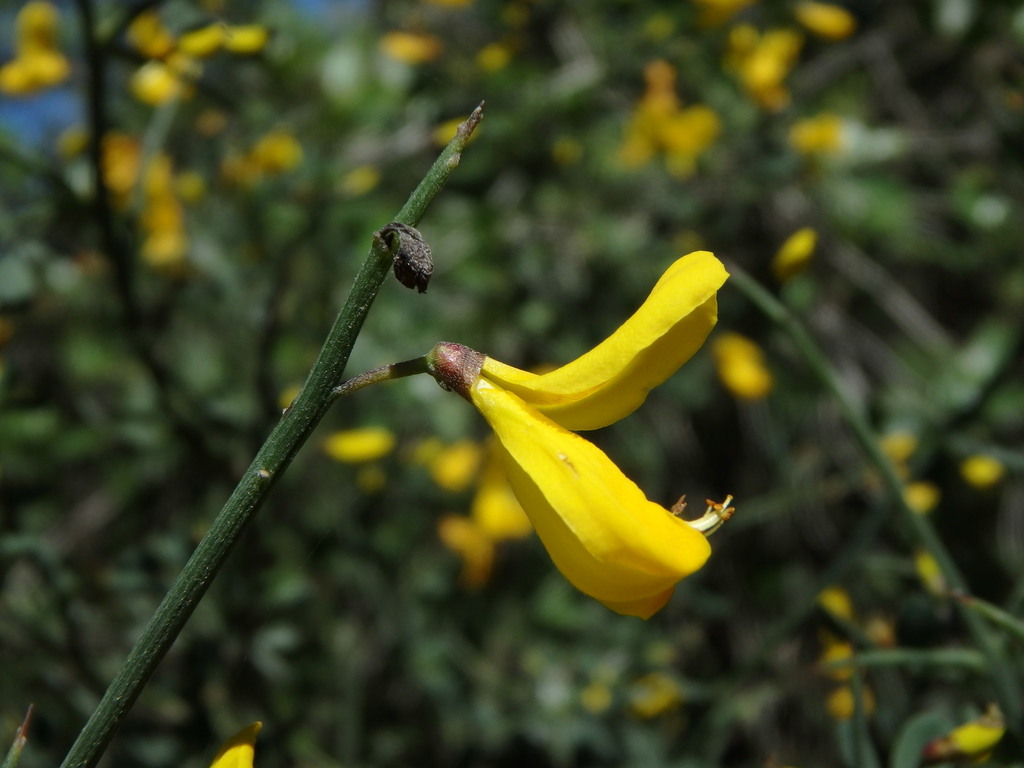
Enter your ZIP to see whether this is legal to plant in your state, and whether it survives your winter.
Spiny Broom is rated fire resistant on balance, but conflicting tests make that a qualified yes.
INRA’s Mediterranean forestry station measured monthly inflammability using ignition frequency and mean ignition delay. Ratings were 0 in May and June, 1 in July and October, and 2 during the other eight months. The July-to-September maximum was 2 on a scale running from 0, little flammable, to 5, extremely flammable. Under INRA’s stated threshold, a fire-season maximum of 2 supports recommending the shrub.
The warning comes from Annals of Forest Science. Its 2017 study classified Spiny Broom as highly flammable based on combustibility and sustainability across fresh- and dried-fuel analysis. That classification addresses more than the monthly ignition behavior measured by INRA. In the same primary study, predried live leaves sampled in September took 32 seconds to reach flaming in a calorimeter. FLAMITS preserves that measurement but applies no common threshold that would turn 32 seconds into a resistant or flammable verdict.
Diputació de Girona and Bombers de la Generalitat de Catalunya gave Calicotome spinosa their “muy recomendada” garden-suitability verdict in the 2020 Spanish edition. Their method combines fire findings with fuel structure, maintenance, origin, invasiveness, species-specific care, and fire-service experience. Thus two approaches support recommending this Fabaceae shrub, while one laboratory classification raises a serious caution about how its fresh and dried fuels burn.
Form
shrub
Region
Algeria; France; Mediterranean France; Spain
Rated in
Catalonia, Spain; Global; Mediterranean France / Provence; Tlemcen Mountains, western Algeria
On this lot
1. Fire evidence and conditions
Fire evidence
Fire-resistant — location does not change the cited classification.
Catalonia, Spain; Global; Mediterranean France / Provence; Tlemcen Mountains, western Algeria
Maintenance
2. Why this plant is relevant here
State distribution
Native range
Introduced / established
USDA hardiness
3. Legal, ecological, and broader status
Legal-list status
Seed-list status
Reported invasive here
Broader regional context
Federal context
How to read this page
The status above is computed from the cited rows below: independent recommendations can support a fire-resistant result, an avoid row can produce keep-away, and disagreement stays visible as conflict. Placement notes preserve each source’s own scheme rather than translating unlike rules into one scale. This is evidence about a plant, not permission to plant it in every part of the defensible space; Zone 0 remains noncombustible.
Where its sources say to plant it
Placement rules below use each source's own distances or named zones, tied to its rating.
They are not interchangeable with the directory's current Zone 0 guidance.
Guía de pirojardinería: suitable inside or outside the 25-metre maximum-risk zone [girona-2020-iuf-25m-suitability] (with its recommendation)
The evidence
Grouped by what each source concluded. Primary evidence rated the plant itself
(a lab, field program, or original curation); corroboration compiled or
republished another source's rating and resolves to its root lineage.
Calicotome spinosa is rated “MUY RECOMENDADA” by the guide's qualitative IUF garden-suitability method. The method assumes species-specific care and integrates fire evidence with fuel structure, maintenance, origin, invasiveness, and expert fire-service experience.
18 cited rows from this source; its identity, lineage and tier are stated once.
Primary study Dehane2017: Dehane, B., Hernando, C., Guijarro, M., & Madrigal, J. (2017). Flammability of some companion species in cork oak (Quercus suber L.) forests. Annals of Forest Science, 74, 60.
Shared row context: plant part leaves; fuel live; device calorimeter; site Dehane2017-1; sampling september.
“time to flaming (s): 32”
FLAMITS record 2290; Ignitability measurement; predrying yes.
FLAMITS record 2360; Consumability measurement; predrying no.
“calorific value (kcal/kg): 4831.85”
FLAMITS record 3944; Combustibility measurement; plant part twigs; fuel live; predrying yes; device calorimeter; site Gillon1997-1; sampling june to september. Primary study Gillon1997: Gillon, D., Hernando, C., Valette, J.-C., & Joffre, R. (1997). Fast estimation of the calorific values of forest fuels by near infrared-reflectance spectroscopy. Canadian Journal of Forest Research, 27, 760-765.
Primary study Saura2010: Saura-Mas, S., Paula, S., Pausas, J. G,. & Lloret, F. (2010). Fuel loading and flammability in the Mediterranean Basin woody species with different post-fire regenerative strategies. International Journal of Wildland Fire, 19, 783.
Shared measurement context: Ignitability measurement; site Saura2010-2.
“temperature at flaming (°C): 546.75”
FLAMITS record 12144.
“time to smoke (s): 114.2”
FLAMITS record 12212.
“temperature at smoke (°C): 171.6”
FLAMITS record 12249.
“time to smouldering (s): 321.4”
FLAMITS record 12285.
“temperature at smouldering (°C): 422”
FLAMITS record 12321.
“flaming duration (s): 444.5”
FLAMITS record 12178; Sustainability measurement; site Saura2010-2.
“temperature at smoke (°C): 171.6”
FLAMITS record 12227; Ignitability measurement; site Saura2010-1.
Primary study Valette1990: Valette, J.-C. (1990). Flammabilities of Mediterranean forest species. Effects on the combustibility of the forest communities inflammabilités des espèces forestières méditerranéennes. Conséquences sur la combustibilité des formations forestières. Revue forestière française, 42, 76-92.
Shared row context: Ignitability measurement; plant part leaves; fuel live; predrying no; device epiradiator; site Valette1990-1; sampling june to september.